Faucets and fixtures
The small jobs that determine how a house feels
A faucet that drips, a shutoff that will not turn, a shower valve nobody can set to the right temperature. None of it is dramatic and all of it is daily. These are short visits that make a house work properly again.
Statewide. Bring your own fixture or ask us what holds up in Kentucky water.
Scope
Fixture work, room by room
Usually grouped into one visit, the labour is in the access, not the fitting.
Kitchen
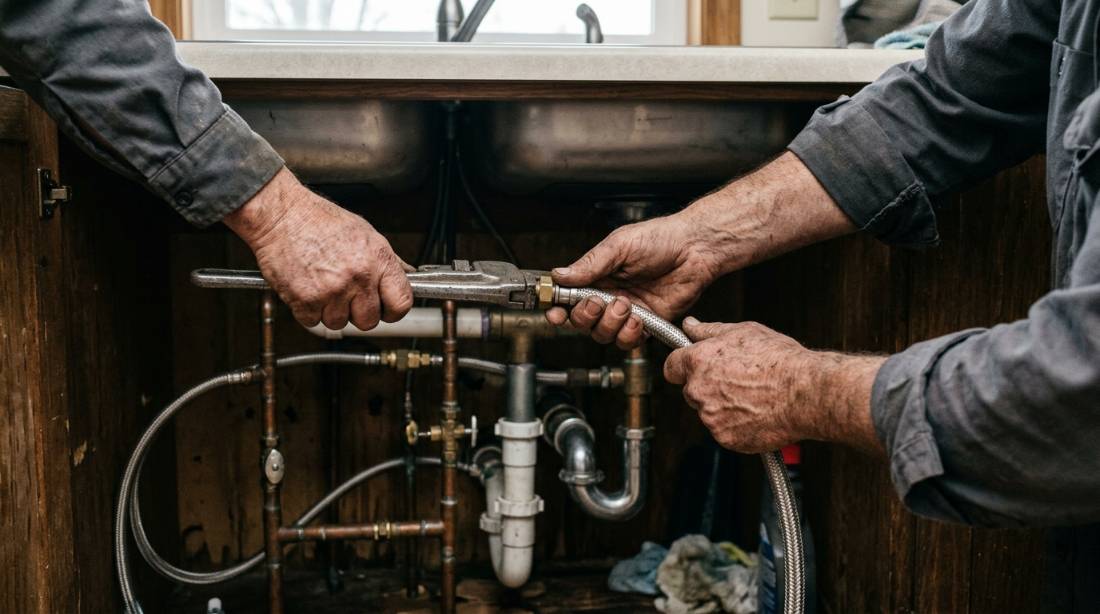
Single-lever and bridge faucets, pull-down sprays, pot fillers, filtered-water taps and the shutoffs beneath. Deep sinks and disposals make the space under a kitchen sink the most crowded cabinet in the house.
Bathroom
Lavatory faucets, widespread and centerset sets, pop-up drains, supply lines and angle stops. Vanity replacement is the natural moment to renew the shutoffs that have been seized shut for fifteen years.
Shower and tub
Cartridge replacement, thermostatic and pressure-balancing valves, diverters, trims and rain heads. Valve bodies mean access behind tile, which is the part worth planning rather than discovering.
Laundry and utility
Washing machine boxes with quarter-turn valves, utility sinks, hose bibs and the braided supply lines that should have replaced the old rubber ones years ago.
A list of small jobs? Group them into one visit and pay for one trip.
Book One VisitHow we work
What a fixture visit involves
Check the shutoffs before anything else
Old multi-turn angle stops frequently will not close, or will not reopen without weeping. We replace them with quarter-turn valves as a matter of course, because the next repair in that cabinet then takes minutes.
Fit the fixture properly, not just tightly
Clean the deck, seat the fixture square, use new braided supply lines rather than the ones that came off, and torque connections by feel and not by force. Overtightened plastic nuts crack weeks later, not on the day.
Test under pressure and tidy up
Run hot and cold, check aerator flow, verify the drain and the pop-up, and look for seepage at every connection with the cabinet dry and a paper towel underneath. Old fixture removed and taken away.
Braided stainless supply lines, every time
The old rubber washing machine hoses and plastic supply lines are the most common single cause of the sudden indoor floods we attend. Replacing them costs very little and removes a genuine risk.
If a faucet is a recognised brand, a cartridge is often available and a repair is the sensible answer. If it is an unbranded import from a big-box shelf, parts usually do not exist, and replacement is the only real option.
Choosing
What lasts in Kentucky water
Finish is taste. These four are engineering, and they decide whether you are calling someone again in three years.
Ceramic disc or cartridge valves
They tolerate mineral-laden water far better than rubber-washer compression valves, and they are rebuildable. This is the single biggest determinant of how long a faucet stays drip-free here.
Solid brass body
Brass bodies with a decent finish survive; zinc alloy castings corrode from the inside and take the cartridge seat with them. Weight in the hand is a surprisingly reliable indicator.
Parts you can still buy in ten years
Established brands publish parts and honour warranties. An anonymous fixture is disposable by design, whatever it looks like on the day it goes in.
Aerators you can remove
In hard water the aerator scales up and flow drops. If it unscrews and cleans, that is a two-minute job forever. If it is integrated and sealed, it is a new faucet.
Nearly every faucet we replace early failed at the valve or the aerator, not the finish. Buy for the internals and the finish will outlive them.
Want a recommendation before you buy? Ask on the call.
Talk to a Pro TodayKentucky specifics
What the local conditions demand
Hard water in the valves, seized shutoffs, and old supply piping behind the wall.
Hard water
Scale is what kills fixtures
Mineral deposits build on cartridge seats, in aerators and in shower heads. Flow drops gradually and drips start where the seat is pitted.
Removable aerators, ceramic cartridges, and a descale rather than a replacement when flow falls off.
Seized angle stops
The reason a small job runs long
Multi-turn stops that have not moved in twenty years often will not close, and force snaps the stem. Then the house main comes into it.
We quote fixture work expecting to replace the stops with quarter-turn valves. It is the difference between one visit and two.
Galvanized supply
Old nipples fail at the thread
In houses with galvanized supply, the short stub behind the wall is corroded and narrow, and disturbing it during a fixture swap can open a leak inside the wall.
If the stub looks marginal we say so before touching it, rather than after.
Freeze-exposed fixtures
Utility rooms and outside walls
Laundry boxes on an exterior wall and utility sinks in unheated spaces are the fixtures most at risk in a Kentucky cold snap.
Quarter-turn valves, insulated pipe and, where it matters, a frost-proof replacement outside.
Send us the list, kitchen, baths, laundry, and we will do it in one visit.
Related work
Fixture work that goes together, and the things behind the wall.
Questions
Fixture work, answered straight
If it is a known brand with available parts, a cartridge or seat kit is cheap and quick and usually the right answer. If it is an unbranded fixture with no parts supply, or the body itself is corroded, replacement is the only lasting option.
Yes, and plenty of people do. Buy solid brass with a ceramic cartridge from a brand that publishes parts, and check the hole configuration of your sink, single-hole, centerset and widespread are not interchangeable without an escutcheon or a new sink.
Usually the aerator, either scaled up already or clogged with debris disturbed during the install. Sometimes it is a supply valve not fully open, or a supply line kinked in a tight cabinet. All quick to check.
Access to the valve body, which usually means opening tile or working from an access panel behind the wall. Swapping the cartridge and trim on an existing valve is straightforward; replacing the whole body is a tile-side job and should be discussed before it starts.
A straightforward swap runs under an hour. Add time for seized shutoffs, corroded supply nipples, a mounting nut nobody can reach, or a sink that has to come out. The unpredictable part is always the cabinet, not the fixture.
By default, unless they are already quarter-turn and working. An old stop that will not close turns every future repair into a whole-house shutdown, so replacing it during a job you are already paying for is the cheapest it will ever be.
They work well and they are genuinely convenient at a kitchen sink. They add electronics, a solenoid and a power source to something otherwise mechanical, so choose a brand whose parts you can still get, and keep the manual override in mind.
That is hard-water scale. Descale the aerators and shower heads, vinegar works, and clean the rim jets on the toilet. If it is aggressive and constant, treating the water is a better use of money than replacing fixtures every few years.
The small jobs, done in one visit
Send the list. Kitchen, baths, laundry, the shutoffs nobody can turn, one trip covers it.