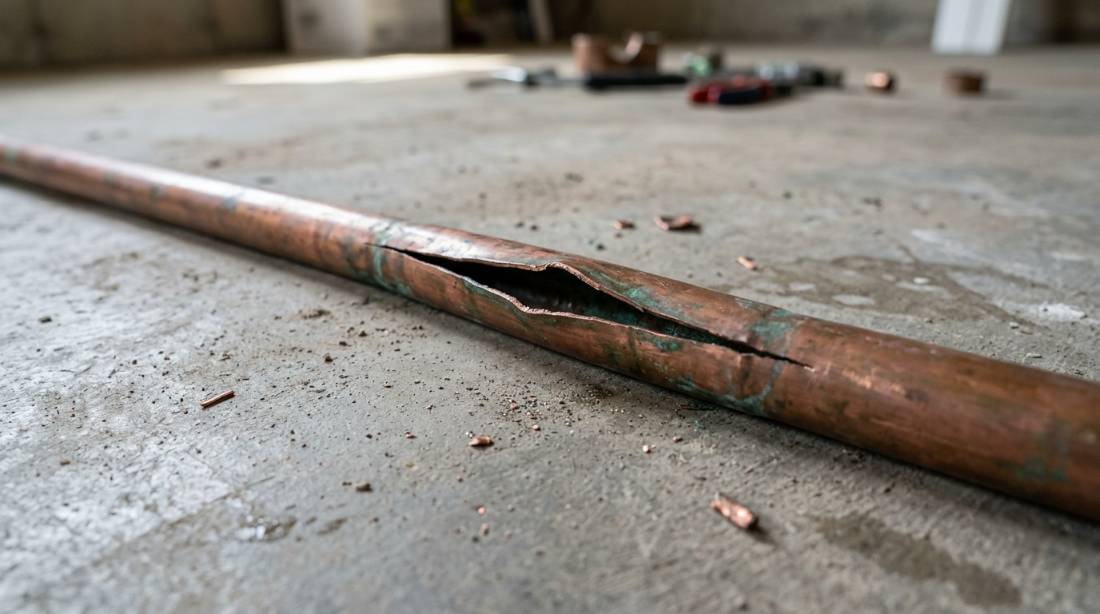
Burst pipe repair
A pipe has let go. Stop the water first, then read the rest of this.
Close the main. Open the lowest cold tap in the house. Kill power to anything the water is reaching. Then call, a burst supply line is a same-hour job, not a same-week one, and the damage bill grows faster than the repair bill.
Twenty-four hours a day, in every Kentucky community we cover.
Right now
Four things, in this order
Main shutoff, closed
Clockwise until it stops turning easily. Basement houses: the wall where the service line enters. Crawl-space houses: usually the meter box at the street. On a well: at the pressure tank, and switch the pump breaker off as well.
Lowest cold tap, open
This drains the standing water in the system out of a sink instead of out of the split. Open a hot tap too once the heater is off. You will hear the pressure come off the pipework within a minute or so.
Water heater, off
Gas valve to pilot or off, or the breaker for an electric unit. A heater firing on a draining tank is a second problem you do not need tonight.
Power, then photos
Breaker off for any circuit the water has reached. Then film the room, the pipe and the water before cleanup, thirty seconds now is worth a great deal to a claim later.
Cannot find the shutoff? Call and describe the house, we can usually talk you to it.
Call for Help Locating ItCauses
Four ways a pipe gives out in Kentucky
Freeze is the famous one and the seasonal one. The other three run all year and account for a surprising share of the calls.
Freeze split
An ice plug forms in the least protected length of pipe and expands against a closed system. The pipe splits along its length, and the flood starts on the thaw rather than in the cold.
Corrosion failure
Galvanized steel rusts from the inside out until the wall is too thin to hold pressure. Common in Kentucky housing built before the 1960s, and often the second or third pinhole on the same run.
Pressure and hammer
Excess incoming pressure, or a valve slamming shut on a long run, hammers joints repeatedly. It fails at a fitting rather than mid-pipe, usually at the weakest solder joint on the line.
Mechanical damage
A screw through a stud, a nail into a run behind drywall, settlement bending a buried line, or a shovel finding a service line in the yard. Sudden, obvious, and unrelated to the age of the pipe.
What is in your walls
Five materials, five different failures
What the pipe is made of decides how it breaks, how it gets repaired, and whether the sensible answer is a section replacement or a conversation about repiping. In a state with this much pre-war and mid-century housing, all five turn up regularly, sometimes in the same house.
Copper
The mid-century and modern standard, and generally excellent. It splits cleanly in a freeze and develops pinholes where water chemistry or a stray current has been working on it. Repairs are straightforward: cut out the section, clean the ends and solder or press in a new length. A run with three pinholes in two years is telling you something about the whole run, not about those three spots.
Galvanized steel
Standard in Kentucky houses into the 1950s and 60s. It rusts internally, which chokes flow long before it leaks, so weak pressure at upstairs fixtures in an older house is often the first symptom. Threaded repairs into brittle old pipe frequently create the next leak, which is why a competent pro will suggest converting a failed section to copper or PEX rather than patching steel to steel.
CPVC
Common in later-century builds and easy to work with. It becomes brittle with age and heat, so it tends to crack rather than split, sometimes at a fitting with no warning at all. Solvent-welded repairs need a cure time before pressure goes back on, which is worth knowing when someone tells you the water cannot come on for an hour.
Polybutylene
Grey plastic supply pipe, mostly installed between the late 1970s and the mid-1990s. It fails at fittings and sometimes mid-pipe, and once a house starts producing polybutylene failures it usually keeps producing them. A repair is legitimate as an emergency measure; the real conversation is about replacing the system.
PEX
The current default, flexible and freeze-tolerant, it can expand somewhat before it fails, which is why it survives a cold night that would split copper. It is not freeze-proof, and it does not like ultraviolet light or careless nails. Repairs are fast: cut, sleeve, crimp, done.
The useful question to ask on site
Not "can you fix this length" but "is this length telling me about the rest of the house". A pro who has been in a hundred houses of this era in your town can usually answer that, and the answer decides whether you are spending money once or annually.
The repair
How the job actually goes
Three phases, and only one of them is about the pipe.
Expose and assess
Open enough to see the whole failure, not just the wet part. On a freeze split that means following the pipe past the visible crack in both directions, because the ice plug was longer than the hole it made. This is where most of the time goes, especially behind tile or above a finished ceiling.
Cut back and replace
Remove the damaged length with clean square cuts, then join in new pipe, soldered or press copper, crimped PEX, solvent-welded CPVC. Where the old material is the problem rather than the incident, the new section is usually a transition to something better.
Pressure up and watch
Water back on slowly, air bled at the highest fixture, then the whole run and every joint checked under working pressure. A second, smaller split further along is common after a hard freeze, and this is when it shows itself, which is why nobody should be closing walls up in the same visit.
Price given on site, before any cutting starts.
After the water stops
The pipe is the cheap half
A section of copper and an hour of labour is a modest bill. Wet insulation in a crawl space, a saturated subfloor, drywall that has wicked water eighteen inches up a stud bay, those are the numbers that hurt, and they are all decided by how long the water ran.
Two practical points. First, wet cavities need to be opened and dried rather than closed up hopefully; anything else is a mould conversation in a few weeks. Second, a plumber is not a restoration contractor, and a good one will say so and tell you what needs a drying company instead of quietly working around it.
If the burst was in a crawl space, which in Kentucky it very often is, get someone to look at the insulation and the vapour barrier as well as the pipe. Sodden batts hold water against joists for months.
Related work
The freeze that caused it, the leak you cannot see, and how to not do this again next January.
Questions
Burst pipes, answered straight
Close the main shutoff, clockwise until it stops turning easily. Then open the lowest cold tap in the house, usually a basement or ground-floor sink, to drain the standing water out of the system rather than through the split. Turn the water heater off at the gas valve or breaker so it is not heating an emptying tank. Kill power to any circuit water is reaching.
A clamp or a repair coupling will stop water tonight, and there are situations where that is exactly the right call, an inaccessible run at two in the morning, for instance. It is not a repair. A freeze split usually extends further along the pipe than the visible crack, so the proper fix is to cut back past the damaged length in both directions and replace the section.
Because ice, not water, does the damage. The expanding plug splits the pipe while everything is still frozen solid, so nothing escapes. Water only starts moving through the crack when the run thaws, which is why so many Kentucky burst-pipe calls come in during a sunny afternoon after a hard night rather than during the cold snap itself.
Whatever has the least protection and the most water sitting still: crawl-space runs, garage walls, exposed lengths in an unheated utility room, the last few feet feeding an outdoor hose bib, and supply lines in exterior walls on the north and west sides. Age matters too, thin-wall galvanized and older polybutylene fail with less provocation than modern copper or PEX.
Policies commonly treat sudden water damage differently from the pipe that caused it, and the distinction is often between damage and maintenance. We cannot tell you what your policy says. What we can tell you is to photograph and film everything before any cleanup, keep the removed section of pipe, and get the invoice itemised, those three things make any claim easier regardless of the outcome.
An accessible section replacement in copper or PEX is often an hour or two of work once the pipe is exposed. Exposure is the variable: a run behind tile, under a slab or at the far end of a tight crawl space can take longer to reach than to fix. If several lengths froze on the same night, which happens, expect the visit to grow.
You can wait, but you are living without water and the split will still be there. The greater risk is a partial split that is holding at low pressure and will not hold when the house is back to normal. Get it looked at before you restore full pressure and leave the house for the day.
Gentle warmth, applied at the fixture end and working back, is reasonable. Open flame is not, it is the fastest way to turn a frozen pipe into a burst pipe or a house fire. If you do not know where the ice is, or the run is inside a wall, that is a call rather than a project.
Every minute of running water is another foot of wet drywall
Get the water stopped and a pro on the way. Twenty-four hours, statewide.