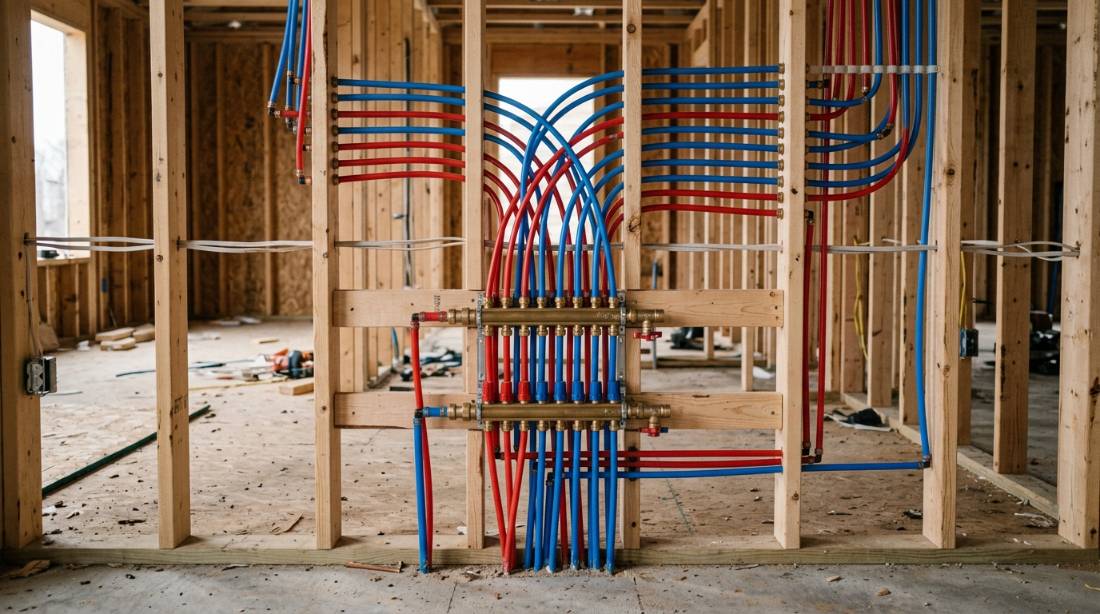
Galvanized pipe replacement
A pipe that closes itself from the inside
Galvanized steel was the supply standard in American houses for the first half of the twentieth century, and Kentucky has a great deal of it left. Its failure mode is unusual: the zinc coating wears away, the steel underneath rusts, and the rust builds inward until a three-quarter-inch pipe passes water like a straw. You do not get a leak. You get less and less water.
Statewide. Most common in pre-1960 housing across the river cities and older county seats.
Symptoms
What rust-choked supply feels like day to day
The symptoms creep up over years, which is why people adapt to them rather than reporting them.
Brown water on first draw
Rust-coloured water when a tap has been sitting, clearing after a few seconds. That is scale and corrosion product shedding off the inside wall of the pipe.
Pressure collapses on a second tap
Shower fine until someone runs the kitchen sink or flushes. A narrowed pipe can supply one fixture and not two, and that is a volume problem rather than a pressure problem.
Hot side worse than cold
Heat accelerates the process, so the hot lines usually choke first and worst. A notably weaker hot side in an old house is close to diagnostic.
Threads that crumble
Any plumber who has disturbed a fitting in your house and found the threads gone has already told you where this is heading. Old galvanized often cannot be worked on without being replaced.
Brown first-draw water and a weak hot side? Worth knowing what is actually in the walls.
Book an AssessmentIdentify it yourself
Three minutes to find out what you have
Find exposed pipe and look at the colour
Basement, crawl space or where supply enters the water heater. Galvanized is dull silver-grey, threaded at every fitting, and goes rust-brown with age. Copper is unmistakably copper. Plastic supply is PEX, CPVC or, if grey or blue with crimp rings, polybutylene.
Scratch it, and try a magnet
A coin scraped on the surface reveals silver-grey under the tarnish on galvanized, and a magnet sticks to steel but not to copper or brass. Two seconds, no tools, complete certainty about the material.
Check whether it is everywhere
Many Kentucky houses were partly updated at some point, copper from the heater to the kitchen, original galvanized to the upstairs bath. Knowing how much is left is what separates a section replacement from a repipe.
Bring this to the call
House age, what material you found and where, whether the hot side is worse than the cold, and whether previous work has replaced part of the system. That is most of the scoping conversation.
One genuinely useful diagnostic: if a plumber has recently replaced a fitting and mentioned that the threads crumbled, treat that as a report on the whole system rather than a comment on one joint. Galvanized that cannot be unscrewed cannot be maintained.
The work
Section, or the whole house
Replacing galvanized is rarely about one bad length. The question is how much of the original system is left and whether it makes sense to do it in pieces.
Section replacement
Where only a defined run remains, a single bathroom branch, or the last stretch to the kitchen, replacing that section restores flow to those fixtures at modest cost. It is a legitimate answer when the rest of the house was already converted.
The transition problem
Joining galvanized steel to copper directly causes galvanic corrosion at the junction, which fails faster than either pipe. A dielectric union or an appropriate brass transition is required. Finding a direct steel-to-copper joint in a house is a sign of past work done badly.
Full repipe
Where most of the original galvanized survives, replacing piecemeal means paying for access repeatedly and improving flow only up to the next narrow section. Doing the house at once, in PEX or copper, is nearly always the better value and it is the usual recommendation.
What comes with it
Correctly sized runs rather than inherited ones, shutoff valves at fixtures that never had them, and the chance to fix an undersized service line at the same time. If the service line from the meter is also galvanized, replacing the interior alone will disappoint you.
You cannot clean galvanized out. The rust is not a deposit on the pipe, it is the pipe, converting itself.
Assess the whole system first. Section work only pays when most of the house is already done.
Talk to a Pro TodayKentucky specifics
Where the galvanized is
The state’s pre-war housing stock, combined with hard water, makes this one of the most common findings in older homes.
Pre-1960 city housing
Whole neighborhoods at once
Old Louisville, the Highlands, Covington and Newport, downtown Lexington, and the older county seats were largely built and plumbed in the galvanized era. Houses on the same street generally share the same story.
If a neighbor has repiped, that is real information about your house rather than gossip.
Hard water
Accelerates the whole process
Limestone groundwater deposits mineral scale that combines with rust to narrow the bore faster than corrosion alone would. Kentucky water is hard nearly everywhere.
It is also why a water softener is often discussed at the same time as a repipe.
Partial updates
The half-converted house
Decades of piecemeal repairs mean many houses have copper in the accessible places and original galvanized in the walls and upstairs. Flow is then limited by whatever narrow section remains.
Replacing the accessible parts again changes nothing. The bottleneck is the part nobody has reached.
Galvanized service lines too
Not just inside the walls
Where the interior is galvanized, the buried service line from the meter frequently is as well, and it chokes in exactly the same way.
No amount of interior repiping fixes a service line that has closed itself. Assess both together.
House age, exposed pipe colour, and whether part of it has been done already.
Related work
The rest of the supply system, and the drains of the same era.
Questions
Galvanized pipe, answered straight
Look at exposed supply pipe in the basement, crawl space or at the water heater. Galvanized is dull silver-grey, threaded at every fitting, and rust-brown with age. Scratch it, silver-grey shows under the tarnish, and try a magnet, which sticks to steel but not copper or brass.
No. The restriction is not a deposit sitting on the wall of the pipe, it is the pipe itself corroding inward. There is nothing to clear that would not also remove what remains of the pipe. Replacement is the only real option once flow has been affected.
Heat accelerates corrosion, so hot lines choke first and more severely. A notably weaker hot side in an older house with galvanized supply is close to diagnostic, and it is often what finally prompts people to act.
The discolouration is iron oxide, which is unappealing rather than acutely hazardous. The more serious concern with old galvanized is that its zinc coating could contain lead impurities and that lead service connections were common in the same era. If that is a concern, testing is the way to answer it rather than speculation.
Sometimes. If most of the house has already been converted and only one branch remains, replacing that run is sensible. If most of the original system survives, piecemeal work means paying for access repeatedly and improving flow only as far as the next narrow section.
Only through a dielectric union or an appropriate brass transition. Direct contact between steel and copper causes galvanic corrosion that fails faster than either pipe alone. Finding a direct steel-to-copper joint in a house is a reliable sign of previous work done badly.
Commonly quoted at forty to sixty years, and much of what remains in Kentucky is well past that. Hard water shortens it. In practice the useful life ends when flow becomes inadequate rather than when the pipe leaks, which is why so much of it is still technically holding water.
Only if the interior pipe is the bottleneck. If the buried service line from the meter is also galvanized, very common in houses of this era, it will have narrowed the same way, and the improvement inside will be disappointing. Both should be assessed together.
Less water every year is not something you have to live with
Find out what is in the walls, and how much of it is left. That is the whole decision.