Sewer line repair
The pipe you own, under the yard you own
In nearly every Kentucky jurisdiction the lateral running from your house to the public main is yours, including the length under the sidewalk and often the street. When it fails, it is your excavation and your bill. Which makes knowing exactly what has failed, and exactly where, the most valuable part of the job.
Statewide. Camera and locate before any quote worth taking seriously.
Symptoms
How a lateral announces itself
A failing sewer line almost never fails suddenly. It gives months of signals that get individually explained away.
The same blockage, again
Cleared in spring, cleared in autumn, cleared again. A line that reblocks on a schedule has a physical cause, roots at a joint, an offset, or a belly holding water, and clearing treats the symptom each time.
Slow everywhere at once
Every fixture in the house sluggish, worst at the lowest level. The shared lateral is restricted, not any individual branch.
A patch of yard that is different
Grass greener and faster-growing in a strip, ground soft underfoot, or a depression forming. Waste water leaking from a broken lateral fertilises and undermines in equal measure.
Smell, or unexplained pests
A persistent sewage smell outside near the run, or a sudden interest from rodents, both point at a break in the line. Rats travel sewers and enter through failures.
Blocked in the same spot twice? That is a pipe problem, and clearing it again will not change it.
Get It Camera InspectedThe process
Diagnose, locate, then choose
Clear enough to see
Flow has to be restored before the pipe can be inspected, so a cable or a jet usually goes in first. This is also the moment the operator learns how the blockage behaves, which is diagnostic in itself.
Camera the full run and locate the fault
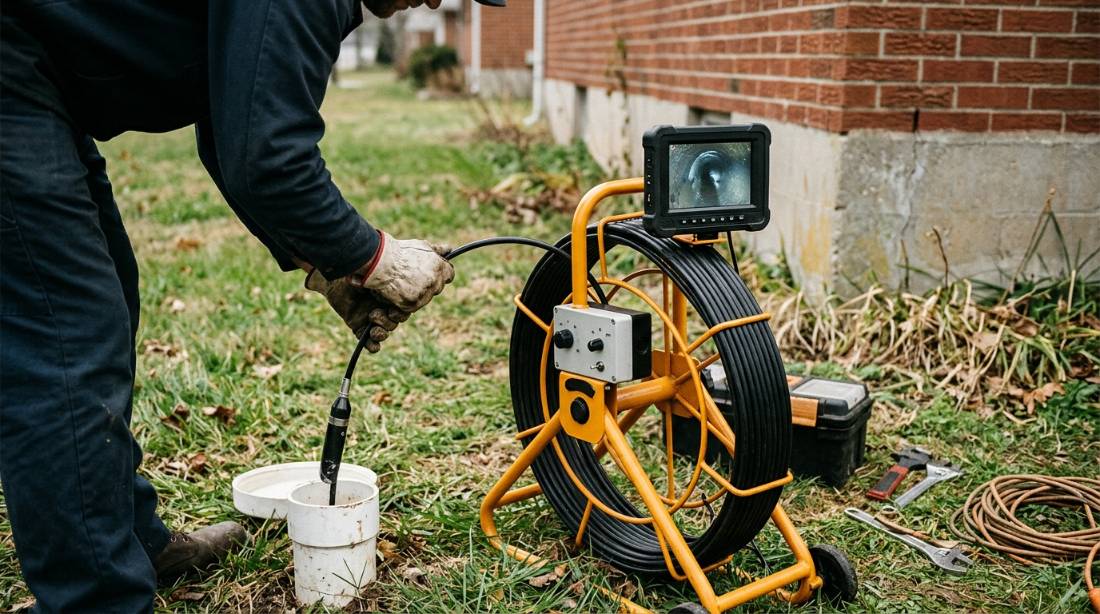
The camera travels to the main connection recording distance, and the locator fixes the position and depth of every defect on the surface. This step decides everything: the length of pipe involved, whether it is one fault or thirty joints, and whether the trouble is inside your boundary.
Match the repair to the finding
One broken joint under an open lawn is a spot dig. Root intrusion along a sound clay run is a lining candidate. A collapsed or Orangeburg line is a replacement. The camera makes that a decision rather than an argument.
Insist on this before accepting a quote
A defect position, a depth, a length of pipe affected, and the footage that shows it. A quote for a sewer repair without those four things is a number, not a scope, and sewer excavation is not a place to discover the scope halfway through.
Also worth establishing early: where your responsibility ends. It varies by city and sanitation district across Kentucky, and in many of them it extends to the main in the street rather than to the property line. The locate distance is what settles it.
Options
Four repairs, in rising order of disruption
The correct repair is the smallest one that addresses the actual defect. The failure mode in this trade is jumping to full replacement when a section would do, and, occasionally, patching a line that is comprehensively finished.
Spot repair
Excavate a few feet, cut out the failed length, sleeve or replace it. Where a camera shows a single break or one offset joint in otherwise sound pipe, this is the right answer and the cheapest one. It depends entirely on trusting the locate.
Cured-in-place lining
A resin-saturated liner is inverted through the existing pipe and cured, forming a new jointless pipe inside the old one. It seals every joint at once, which is exactly what a root-intruded clay lateral needs, and it needs only access pits rather than a trench. It requires a host pipe with enough structural integrity to line against.
Pipe bursting
A bursting head is pulled through the old pipe, fracturing it outward while towing new HDPE behind. It replaces the line entirely along the same path, from two small pits, and it can upsize the diameter. This is the usual answer for collapsed or Orangeburg lines under a landscaped yard or a driveway.
Open-cut replacement
A trench along the run. Still the right choice where the line has multiple faults at varying depth, where grade has to be re-established because of a belly, or where the ground and utilities rule out trenchless. More disruptive, and often less expensive per foot in an open yard with shallow pipe.
The difference between a spot repair and a replacement is frequently one camera pass and a locate. That hour decides the size of the number.
Scope, then price. Ask what would have to be true for a smaller repair to work.
Talk to a Pro TodayKentucky specifics
Why laterals fail here
Old pipe materials, mature trees and limestone ground account for the great majority of failures across the state.
Clay and Orangeburg
What is actually in the ground
Vitrified clay laterals, jointed every few feet, are everywhere in pre-1970 Kentucky housing, and post-war construction added bituminised fibre conduit that deforms and delaminates with age.
Clay can often be lined. Orangeburg essentially cannot, which is why identifying the material is the first thing the camera does.
Mature street trees
Roots find every joint
Established neighborhoods in Louisville, Lexington, Covington and the older river towns pair large trees with jointed clay. Roots enter at joints, thicken, and catch everything that passes.
Cutting roots is maintenance. Sealing the joints, lining or replacement, is the repair.
Karst and settlement
Ground that moves
Limestone dissolution, sinkhole activity and ordinary settlement pull joints apart and rob sections of their fall. The pipe was laid correctly; the ground under it did not stay put.
A belly caused by settlement will not be fixed by any amount of cleaning, grade has to be restored.
Permits and utility rules
Every jurisdiction differs
Sewer work is permitted and inspected everywhere in Kentucky, and where your responsibility ends varies between MSD, the Northern Kentucky districts and individual city systems.
Establish it before work starts. The locate distance is the evidence that settles it.
How often it blocks, whether the yard is wet, and the age of the house.
Related work
The steps either side of a repair.
Questions
Sewer line repair, answered straight
In most Kentucky jurisdictions, yes, from the house to the connection with the public main, and in many systems that includes the portion under the sidewalk and street. Rules differ between MSD, the Northern Kentucky districts and individual city systems, so confirm with your utility. The camera locate is what establishes where a defect actually sits.
Frequently. Cured-in-place lining rebuilds the pipe from the inside through access pits, and pipe bursting replaces it along the same path from two small excavations. Both depend on what the camera finds, lining needs a host pipe with enough integrity, and bursting needs a clear path free of conflicting utilities.
Condition and material. A clay line that is structurally sound but leaking at the joints is an ideal lining candidate. A collapsed pipe, an Orangeburg line, or a run with a belly that needs its grade restored cannot be lined durably and wants replacement. The inspection makes this a straightforward call rather than a judgement.
A sagging section that has lost its fall and holds standing water, so solids settle and the line reblocks in the same place. Cleaning never resolves it. The repair is to excavate and regrade that length, or to reline in a way that restores flow, but it must be addressed rather than cleaned around.
A spot repair on a shallow line in an open yard is often a day. Lining a residential lateral is typically one to two days including cure time. A full replacement depends on depth, length, surface reinstatement and whether the street is involved, and permitting adds lead time in most jurisdictions.
That is exactly what trenchless methods are designed to avoid. Where the run passes under a drive, walkway or mature landscaping, lining or bursting usually needs only pits at each end. Where the line has to be regraded or has faults at multiple depths, open excavation may be unavoidable.
Not by cutting them. Cabling and jetting clear the intrusion and buy a season or two, but the roots return because the opening is still there. Permanently means eliminating the entry point, lining the pipe so it has no open joints, or replacing the run.
It is a fair signal. Houses in the same neighborhood were usually built in the same period with the same materials, connected to the same main, under the same trees and the same ground conditions. A camera inspection is a cheap way to find out whether you are on the same timetable.
Know the length, the depth and the defect before you agree a price
A camera pass and a locate turn a five-figure guess into a scope you can compare.