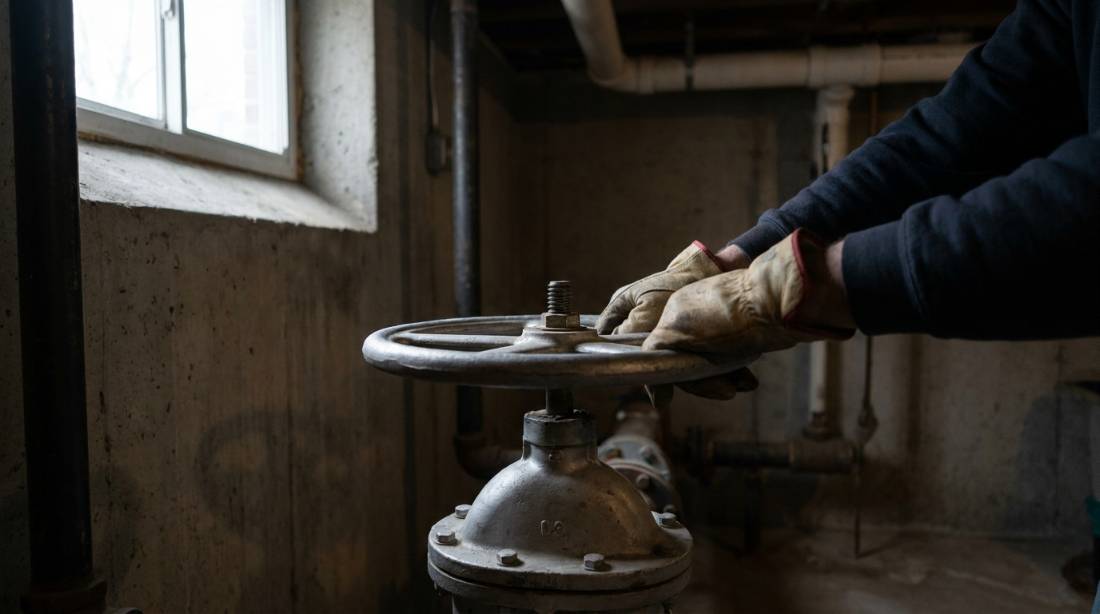
Pressure regulators
Too much pressure costs more than too little
Low pressure is annoying. High pressure is expensive, it fails water heaters early, splits supply lines, blows out fill valves and turns small leaks into burst pipes. A twenty dollar gauge tells you which one you have.
Statewide. If you have never measured your static pressure, measure it before anything else.
Symptoms
How a bad regulator announces itself
Regulators fail in both directions, and each failure mode has its own signature.
Banging and hammering
A shudder in the walls when a tap or an appliance valve shuts. High static pressure makes the shock worse and puts every joint in the house under repeated stress.
Dripping relief valve
The water heater’s temperature and pressure valve weeping is a pressure symptom far more often than a heater fault, high supply, a closed system with no expansion tank, or both.
Pressure that changes on its own
Fine in the evening, brutal at 5am. Municipal pressure rises when demand drops overnight, and a regulator that has lost control lets that straight into the house.
Weak flow everywhere at once
A regulator can also fail closed or clog, dropping the whole house at every fixture simultaneously. One bad fixture is a fixture problem; all of them together points upstream.
Fixtures failing early? Measure the pressure before replacing anything else.
Book a Pressure TestHow we work
Test, then replace or adjust
Measure static and overnight pressure
A gauge on an exterior bib or the laundry tap gives static pressure in seconds. Where the complaint is intermittent we leave a recording gauge overnight to catch the 4am peak that no daytime test will find.
Establish whether the system is closed
A check valve, backflow preventer or the regulator itself makes the system closed, so heated water has nowhere to expand. That needs a thermal expansion tank, and its absence explains a great many weeping relief valves.
Replace or set, then verify
A regulator that has lost control is replaced, not adjusted, the internals are worn. New valve fitted with a union and, where none exists, a gauge left in place. Set to the target and verified at fixtures at both ends of the house.
Where the pressure should sit
Most codes cap fixture pressure at 80 psi. In practice 50 to 60 psi gives good showers, quiet pipes and a long life for appliances and joints. Above 80 you are shortening the life of everything downstream.
Regulators are wear parts. Ten to fifteen years is typical, and a house with high incoming pressure or gritty water gets less. If yours is original to a house built in the nineties, it is not doing what you think it is.
Why it matters
What high pressure is quietly doing
The damage is cumulative and it shows up as a series of unrelated-looking failures.
It shortens appliance life
Washing machine and dishwasher fill valves, ice maker lines, toilet fill valves and faucet cartridges are all rated for a pressure range. Run them at 100 psi and they fail years early, one at a time, at your expense.
It turns weeps into bursts
A marginal joint or a corroded section that would seep at 55 psi can let go at 100. High pressure is the single most common aggravating factor behind the burst supply lines we attend.
It wastes water constantly
Every fixture flows more than it needs, every leak leaks faster, and every flush uses more. The volume difference across a whole house at high pressure is not trivial on a metered bill.
It makes the plumbing loud
Hammer, shudder and hissing fixtures are pressure symptoms. Households often assume old pipes are simply noisy, and are surprised how quiet the house becomes once pressure is correct.
Nobody calls a plumber about high water pressure. They call about the third appliance that failed, and the pressure gauge explains all three.
One measurement settles it. Then either it is fine, or it is fixable.
Talk to a Pro TodayKentucky specifics
What the local conditions demand
Hill-country terrain, a lot of pressure zones, and hard water passing through the valve.
Terrain and pressure zones
Elevation drives high supply
Kentucky water systems serve hilly ground, and a house at the bottom of a zone can see pressure set for a hill above it, well beyond what fixtures are rated for.
These houses need a working regulator, not an optional one, and it should be checked every few years.
Overnight peaks
The damage happens while you sleep
System demand drops at night and pressure climbs. Daytime tests read normal in houses whose fixtures are being hammered at 4am.
Where symptoms are intermittent we leave a recording gauge on overnight rather than guessing.
Hard water
Regulators wear from the inside
Mineral-laden water abrades and scales the seat and diaphragm, so a Kentucky regulator often reaches the end of its useful control earlier than the catalogue suggests.
A gauge fitted alongside the new valve means the next failure is noticed, not discovered through damage.
Closed systems
Expansion has to go somewhere
Where a regulator, check valve or backflow preventer closes the system, water heated in the tank cannot expand back toward the main and pressure spikes hard.
A thermal expansion tank is required in that situation, and it is the fix for most weeping relief valves.
Tell us what is failing and whether the noise is worse at night.
Related work
What high pressure damages, and the supply work it often accompanies.
Questions
Pressure regulators, answered straight
Between 50 and 60 psi suits most houses, strong showers without punishing the plumbing. Code generally caps fixture pressure at 80 psi. Anything above that is actively shortening the life of appliances, fixtures and joints.
A screw-on gauge from any hardware store, fitted to an exterior hose bib or the laundry tap with everything else in the house off. That reading is your static pressure. It is the cheapest diagnostic in plumbing.
Usually a bell-shaped brass valve on the main just after it enters the house, often near the shutoff or the meter, with an adjusting screw on top. Many rural and older properties have none at all, which is fine only if the incoming pressure is genuinely moderate.
If it still holds a setting, yes, the adjusting screw shifts the target and we verify at the fixtures. If it cannot hold, or pressure creeps back up overnight, the internals are worn and adjustment is a temporary illusion.
Ten to fifteen years is typical, and hard water shortens it. A house on original hardware from twenty years ago should assume the regulator needs testing, whatever the symptoms.
Most often pressure, not the heater. Either supply pressure is too high, or the system is closed and lacks a thermal expansion tank so heating the water spikes the pressure. Both are pressure fixes, and replacing the heater does not solve either.
Not by itself. A regulator can only reduce. If pressure is genuinely low, the causes are a failed-closed regulator, a partly closed valve, a corroded or undersized supply line, or a real problem at the main, all of which we test for rather than assume.
It is main-line work: the house is isolated, the valve is cut in, and getting the orientation or the union right matters. If it is soldered or in an awkward crawl-space position, the cost of doing it twice exceeds the cost of doing it once properly.
Measure it before it costs you another appliance
A pressure test takes minutes and either rules out the problem or explains several others at once.