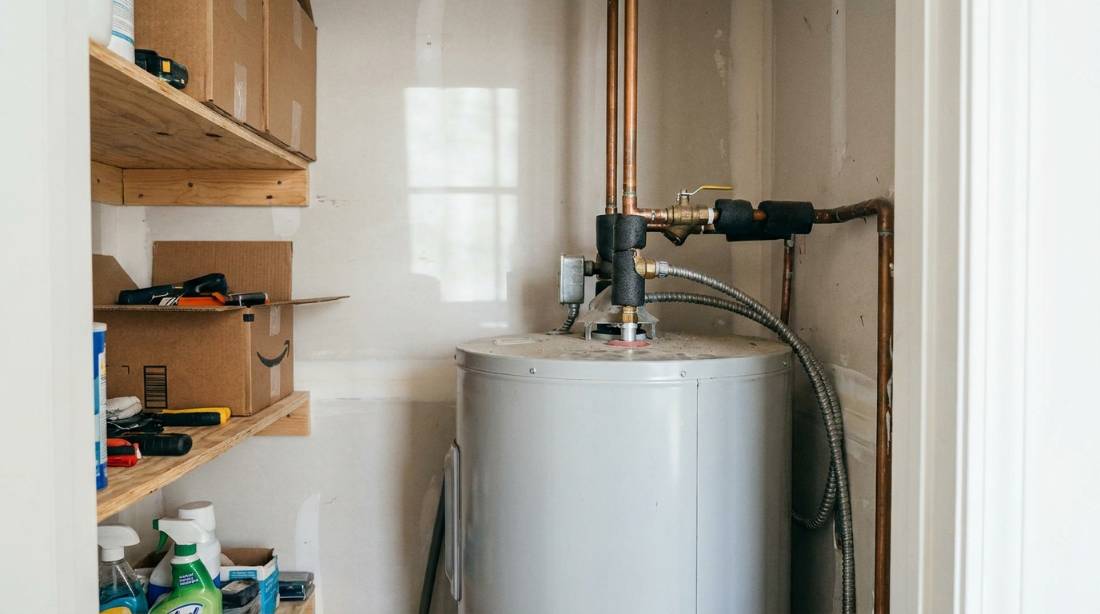
Water heater repair
Some of these are a repair. One of them is not.
A water heater that has stopped heating, heats too little, or makes a noise like gravel in a bucket is usually fixable, and often cheaply. A water heater leaking from the tank itself is not fixable at all. Knowing which of those you have is the first two minutes of the conversation, and it decides everything after it.
Statewide. A leaking tank is a same-day call, shut the water off first.
Triage
Four situations, four different answers
Start here. The distinction between these is worth more than any amount of guessing about brands.
Water on the floor around the tank
Check whether it is coming from a fitting, the relief valve discharge, or the tank body itself. A fitting or a valve is a repair. Weeping from the tank means corrosion has perforated it, and no repair exists.
No hot water at all
On gas, usually a pilot, thermocouple or gas control fault. On electric, usually a tripped high-limit reset, a failed element or a thermostat. All are ordinary repairs and none of them mean a new heater.
Runs out too fast
A failed lower element on an electric heater, a broken dip tube, heavy sediment eating capacity, or a tank simply too small for how the household has changed since it was installed.
Rumbling, popping, banging
Sediment on the bottom of the tank trapping steam under it. Flushing helps early on; a heavily sedimented tank is losing both efficiency and life, and the noise is the warning.
Water pooling under the tank? Shut the cold supply off at the valve above it and call.
Get Someone OutBefore you call
Three checks, five minutes, no tools
Electric: press the reset
Behind the upper access panel is a red high-limit reset button. If it has tripped, pressing it may restore hot water immediately. If it trips again, stop, something is causing it and that something needs diagnosing rather than resetting repeatedly.
Gas: look at the pilot and the status light
Most modern gas heaters have a small indicator that flashes a diagnostic code, and the manual on the side of the tank decodes it. An out pilot on an older unit may relight; one that will not stay lit points at the thermocouple or the gas valve.
Everyone: find the shutoffs and read the label
The cold water shutoff above the tank and the gas valve or breaker. Then read the rating plate: age or serial number, capacity, and fuel. Age above ten to twelve years changes the whole repair-or-replace conversation.
Bring this to the call
Gas or electric, capacity, the age off the rating plate, exactly what is happening, and whether there is any water on the floor. That is enough for an experienced person to tell you on the phone whether this is likely a part or a replacement.
A safety note worth taking seriously: if the temperature and pressure relief valve is discharging, do not cap it, plug it or ignore it. That valve is the only thing standing between an overheating tank and a genuinely dangerous failure. Discharge means something else is wrong, and it needs looking at rather than silencing.
Common repairs
What actually gets fixed
Most water heater faults are one of a small number of components, all of which are inexpensive relative to a new unit.
Thermostats and elements (electric)
A failed lower element gives you a short burst of hot water and then cold, the classic symptom. Elements and thermostats are cheap parts and a routine job. In Kentucky’s hard water, scale on an element is a common cause of premature failure.
Thermocouple, pilot and gas valve (gas)
A pilot that will not stay lit is most often the thermocouple, an inexpensive part. A gas control valve is dearer, and on an older tank its cost starts to approach the replace-instead threshold. Venting should be checked at the same time as a matter of course.
Sediment flushing
Hard water drops mineral to the bottom of the tank, where it insulates the burner from the water, causes the rumbling, and steals capacity. Flushing annually genuinely extends life. A tank that has never been flushed in ten years may not benefit much, and disturbing heavy sediment occasionally reveals a hole that was being plugged by it.
Anode rod
A sacrificial magnesium or aluminium rod that corrodes so the tank does not. Once it is consumed, the tank starts to. Replacing it at around the five-year mark is the single most effective thing anyone can do to extend the life of a water heater, and almost nobody does it.
The one that is not a repair
A tank leaking from its body. Corrosion has perforated the steel, and there is no patch, weld or sealant that is worth attempting. Shut off the water and the fuel or breaker, and plan a replacement.
Ten years old and needing an expensive part is usually the moment to replace. Four years old and needing the same part is obviously a repair. The age on the rating plate does most of the arguing.
Diagnose first. Plenty of dead heaters are a twenty-dollar part.
Talk to a Pro TodayKentucky specifics
Why heaters here work harder
Hard water is the dominant factor, and it shortens the life of everything in the tank.
Hard water
Sediment and scale
Limestone groundwater deposits mineral in the bottom of the tank and on electric elements continuously. It insulates the burner, reduces effective capacity, causes the characteristic rumbling and shortens tank life.
Annual flushing and a softener are the two things that actually change this. Everything else is managing the symptom.
Unheated spaces
Garages, crawl spaces and basements
A great many Kentucky heaters live somewhere unconditioned, which costs standby heat all winter and puts the supply connections at freeze risk in a hard January.
Insulating the first few feet of hot and cold pipe at the tank is cheap and genuinely worthwhile.
Well water
Iron, sulphur and sediment
On a private well, common across the eastern and western counties, sediment load and hydrogen sulphide both attack the tank. The rotten-egg smell in hot water is usually a reaction between sulphur and the anode rod.
Changing the anode type frequently solves the smell where treatment is not practical.
Age of the housing stock
Undersized for how people live now
A forty-gallon tank fitted for a 1970s household is routinely asked to serve two extra bathrooms and a larger family today.
Running out of hot water is sometimes a sizing question rather than a fault, and that is worth establishing before paying to repair anything.
Gas or electric, age off the label, and whether there is water on the floor.
Related work
Replacement, and what makes the next one last.
Questions
Water heater repair, answered straight
It depends entirely on where from. A leaking fitting, drain valve or relief valve is a straightforward repair. Water weeping from the body of the tank itself means corrosion has perforated the steel, and there is no repair worth attempting. Shut off the cold supply and the fuel or breaker, and plan a replacement.
On an electric heater, a failed lower element is the classic cause, you get a short burst and then cold. Other candidates are a broken dip tube, heavy sediment stealing capacity, or a tank that is simply too small for how the household has changed. All are worth diagnosing before buying anything.
Sediment on the bottom of the tank trapping pockets of steam that collapse as they escape. It is extremely common in hard Kentucky water. Flushing helps if it is caught reasonably early; a tank that has rumbled for years has usually lost both efficiency and life to the same deposit.
Eight to twelve years for a typical tank unit, and hard water pulls that toward the lower end. Age is the most useful single number in a repair-or-replace decision: an expensive part in a ten-year-old tank rarely makes sense, while the same part at four years obviously does.
Yes, annually, and in Kentucky water it matters more than average. Draining a few gallons from the bottom removes sediment before it accumulates. One caveat: a tank that has never been flushed in a decade may have sediment plugging a corroded spot, and disturbing it occasionally reveals a leak that was already there.
No, never. The temperature and pressure relief valve is the safety device that prevents a genuinely dangerous failure. Discharge means either the valve has failed or something is causing excess temperature or pressure, possibly a thermal expansion problem. Both need diagnosing, not silencing.
A sacrificial rod that corrodes in place of the tank. Once it is consumed the tank begins to corrode instead. Replacing it at around five years is the most effective life-extension available for a water heater, and it is almost universally skipped. In hard water it is consumed faster.
Usually a reaction between sulphur in the water and the magnesium anode rod, most common on well systems. Switching to an aluminium-zinc anode frequently resolves it. If the smell is in both hot and cold water, the source is the supply itself and treatment is the answer rather than anything in the heater.
Before you buy a new one, find out what it needs
Plenty of dead water heaters need an inexpensive part. Plenty of others should not be repaired at all. Age and symptom settle it.