Emergency plumbing
Somebody answers, and somebody comes out, any hour, anywhere in Kentucky
Water you cannot stop. Sewage coming back into the house. No water at all in the middle of winter. These are the calls that cannot wait for business hours, and the phone is covered for them twenty-four hours a day, in all 509 communities we serve.
If water is escaping and you can safely reach the main shutoff, close it before you finish reading this page.
Triage
What is genuinely an emergency, and what is not
Nobody benefits from an after-hours call-out for a dripping tap. Here is the line we draw, plainly.
Call immediately
Water, waste or gas that is out of control
A burst or split supply line. Water coming through a ceiling. Sewage backing up into a basement, a tub or a floor drain. No water at all when the temperature is below freezing. Any smell of gas, gas utility first, then us.
These share one feature: every hour that passes makes the repair bigger. Saturated drywall, wet insulation and soaked subfloor are separate costs from the pipe itself, and they accumulate quietly while you wait.
Same day
Contained, but getting worse
A water heater weeping from the tank rather than a fitting. One drain that has stopped completely while the rest still run. A toilet that will not stop refilling. A supply line that is dripping into a bucket you keep emptying.
None of these will flood the house tonight, but they are all on a clock. Booked in daylight they are ordinary jobs; left a week, several of them stop being ordinary.
Next few days
Annoying, not urgent
A slow drain that still empties. A dripping faucet. A hose bib that weeps when opened. Low pressure at one fixture. A water heater that has started making noise but is still producing hot water.
Worth handling before winter or before you have visitors, and cheap to fix while it is still small. Bundle several of them into one visit rather than paying for three separate trips.
Somewhere between the columns? Describe what you are seeing and we will tell you honestly which one it is.
Ask Us NowBefore anyone arrives
The first five minutes are yours, and they matter
Stop the water
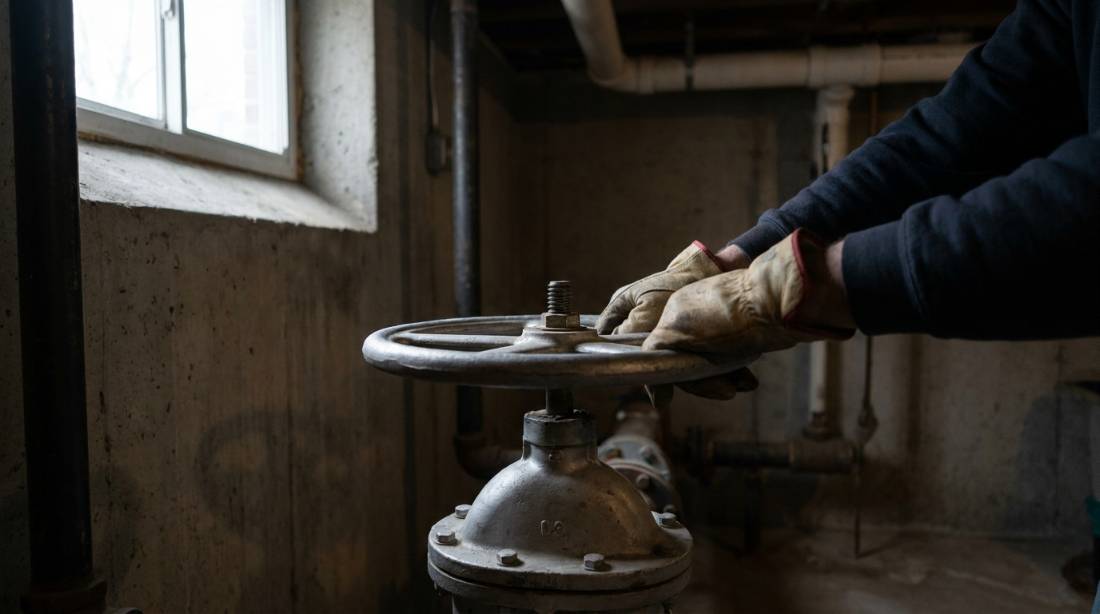
Try the fixture valve first, under a sink, behind a toilet, on the wall at a washer. If there is no valve, if it will not turn, or if you cannot see where the water is coming from, go to the main and close it clockwise until it stops.
Kill power to anything wet
Switch the circuit off at the breaker panel, not at the wall switch. Water reaching a ceiling light, a basement outlet or a furnace is an electrical problem on top of a plumbing one. If the panel itself is in standing water, do not touch it.
Then call, and keep the phone near you
The pro on the way may want to ask something on approach, where to park on a narrow street, whether the crawl space hatch is accessible, which door to use. On a hillside property in the eastern counties that conversation can save half an hour.
Where the shutoff usually is, by house type
- Basement house, older city neighborhood: on the wall where the service line comes through, usually at the front, close to the meter. Frequently behind stored boxes, which is worth fixing today rather than tonight.
- Crawl-space house: often nothing accessible inside, so the working shutoff is the meter box at the street with a lid you lift. A meter key costs very little and lives better in a kitchen drawer than in nobody's hands.
- Slab-on-grade build: commonly in the garage or a utility closet where the line rises through the slab, sometimes outside on the hose-bib wall.
- On a well: at the pressure tank. Killing the pump breaker as well stops it trying to refill a line that is emptying into your house.
Do not do this one
Do not keep flushing or running water to "clear" a backed-up sewer line. If the line out of the house is blocked, everything you send down it comes back into the lowest fixture in the building, usually a basement floor drain or shower.
What we ask, and why
Four questions that decide who we send
An emergency dispatch is a matching problem, not a queue. The difference between a first-visit fix and a second appointment is usually whether the right equipment came out with the right person, and that is decided in the first ninety seconds of the call.
Your town and ZIP code. Not to be bureaucratic, Kentucky has a lot of small communities with similar names, and the ZIP is what actually resolves which pros cover you and how far they are driving at this hour.
What you can see, in one sentence. "Water running down the kitchen ceiling" and "water pooling at the base of the toilet" go to different tools. Guessing at the cause is not required; describing the evidence is.
Basement, crawl space or slab. This changes almost everything about how a leak is found and reached. A crawl-space house needs someone willing and equipped to get under it at night; a slab house needs locating gear before anybody cuts concrete.
City water and sewer, or well and septic. Off the municipal system the pressure source, the shutoff and the responsibility line are all different, and so is the diagnosis when a fixture loses pressure.
The right question on the phone is worth more than the fastest truck. Tell us what the house is, not just what the leak is.
Have those four answers ready and the call takes about two minutes.
Start the CallThe overnight list
Five emergencies that make up most of the after-hours phone traffic
1. A split supply line, usually after a cold night
Copper and CPVC both fail the same way in a freeze: the ice plug expands, the pipe splits along its length, and nothing happens until the thaw pushes water through the crack. That is why the flood so often starts in the afternoon of a mild day rather than during the cold snap itself. The repair is a section replacement, cut back past the damage in both directions, because a split rarely stops neatly where it looks like it stops.
2. Sewage backing up into the lowest fixture
A blocked lateral does not announce itself at the kitchen sink; it announces itself at the basement floor drain, because water finds the lowest opening. Roots at an open joint, a collapsed section of clay or cast iron, and years of grease are the usual causes, and heavy Kentucky spring rain is the usual trigger. Camera work before excavation is the difference between a spot repair and a guessed trench.
3. No water at all
In winter this is almost always a frozen run rather than a supply failure, and where it froze is predictable: the least protected length of pipe. Crawl space, garage, exterior wall, or the last few feet before a hose bib. On a well it can equally be a failed pump, a waterlogged pressure tank or a tripped pressure switch, which is a different visit with different parts.
4. A water heater that has let go
A tank leaking from a fitting is a repair. A tank weeping from the shell is done, and the useful decision at midnight is only how to stop the water: close the cold inlet, kill the gas or the breaker, and open a hot tap downstairs to relieve pressure. Forty gallons on a finished basement floor is a different problem from forty gallons in a garage, and that changes how urgently anyone drives.
5. The smell of gas
This one is not ours first. Leave the building, do not operate switches, and call the gas utility from outside. A plumber handles the appliance side and the house gas lines once the utility has made the situation safe, that sequence matters, and any pro worth calling will tell you the same thing.
Recognise yours in that list? The description above is enough for us to send the right person.
Get Someone Out TonightResponse, region by region
Why an emergency in Pikeville is not the same dispatch as one in St. Matthews
Same broken pipe, very different night. Distance, access and what is under the house all move the honest answer around.
Metro Louisville and Lexington
Dense coverage, short drives, and mostly basement houses where the shutoff and the leak are both reachable. Overnight arrival inside a couple of hours is the normal expectation, and older neighborhoods mean cast-iron waste and galvanized supply are likely to be part of the story.
River towns and county seats
Good coverage, slightly longer drives. High groundwater in the bottoms means an excavation can find water before it finds the pipe, so overnight digging is often deliberately deferred to daylight, the emergency work is stopping the water, not finishing the repair.
Mountain and rural counties
Long drives on steep gravel, crawl spaces rather than basements, and frequently a well and septic. Access decides everything: whether a truck can reach the property at all is the first question, and the plain answer is sometimes first light rather than tonight.
Tell us your town and we will tell you what tonight actually looks like.
Money, plainly
What an emergency call costs, and how you find out
We do not publish prices, and we will not invent one on the phone. Anyone who quotes a burst-pipe repair sight unseen at eleven at night is guessing, and the guess is either padded to be safe or revised upwards once they arrive. Neither helps you.
What we insist on instead is sequence. The pro assesses the job in front of them, tells you the price, and starts only once you have agreed to it. If opening a wall or lifting a floor changes the picture, and on hundred-year-old pipework it sometimes does, the work stops and you hear about the change before anyone continues.
Three things genuinely move the number: access, because reaching a pipe under a crawl space or through tile is most of the labour; hour, because after-hours rates are real; and how much of the pipe is bad, which is only knowable once it is exposed. Insurance often covers the water damage while treating the failed pipe as a maintenance item, so photograph everything before anything is cleaned up.
Worth doing tonight, while you wait
Photograph and video the water, the pipe and the affected rooms before cleanup starts. It costs nothing and it is the difference between a straightforward claim and an argument.
Where emergency calls usually end up
The specific jobs behind most after-hours dispatches, each explained in full.
Questions
Emergency plumbing, answered straight
Yes. The phone is covered twenty-four hours a day, every day, including holidays. Overnight the conversation is shorter and more practical: what is happening, where you are, whether the water is off. If the honest answer is that nobody can safely reach you until first light, you will be told that rather than left waiting for a truck that is not coming.
It depends where you are, and we will not pretend otherwise. In Louisville, Lexington and Northern Kentucky there are usually several pros within a short drive and arrival inside a couple of hours is normal overnight. In the mountain counties and the smaller western towns the drive itself can be the largest part of the wait. You get a realistic window on the call.
Shut the water off if water is escaping, at the fixture if there is a working valve, at the main if not. Kill power to any circuit that water is reaching, at the breaker rather than the switch. Move what you can out of the way and put towels down. Do not run appliances that drain into a blocked line, and do not try to force a blocked sewer with more water.
In a Kentucky house with a basement it is usually on the wall where the service line enters, often near the front of the house and close to the meter. In a crawl-space house it is frequently at the meter box outside near the street, under a lid. On a well it is at the pressure tank. Worth finding it in daylight, while you can still see it and turn it easily.
After-hours work generally does, and that is normal for the trade. What matters is that the number is not a surprise: the pro who attends assesses the job on site and gives you a price before starting. We do not quote figures over the phone, because the honest answer depends on access and on what is found once something is opened up.
If the water is loose inside your house, or on your side of the meter, call us. If the meter itself is spinning with everything off inside, if water is bubbling up in the street, or if a whole street has lost pressure, that is the utility. A smell of gas is the gas utility first and immediately, then a plumber for the appliance side afterwards.
Treat it as one. Anything coming back up a floor drain, a basement toilet or a laundry standpipe means the line out of the house is not moving, and every further flush adds to it. Stop using water in the house, keep people and pets away from the affected area, and call. Waiting until morning usually means more of the house is involved by then.
We say so. Water tracking down an interior wall can be a roof or flashing problem, a failed HVAC condensate line or a window detail rather than a pipe. Sending a plumber to a roof leak wastes your money and our reputation, so if the description points elsewhere we will tell you which trade to call instead.
It is worse in twenty minutes than it is right now
Twenty-four hours a day, 509 Kentucky communities, and a realistic arrival time rather than a comforting one.