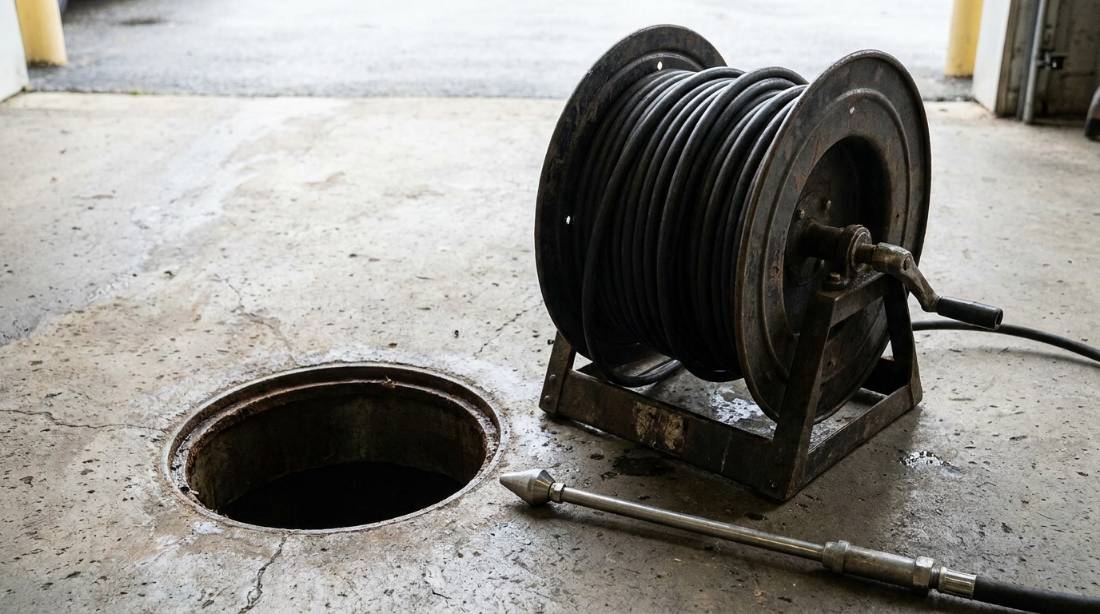
Drain cleaning
Clearing it is easy. Knowing why it blocked is the job.
Any drain can be opened. The question worth paying for is whether it blocked because of what went down it last week, or because the pipe itself has scale, a belly, a broken joint or roots. One of those answers means a cable; the other means a camera and a plan.
Statewide, and same-day where the schedule allows.
Reading the symptom
One drain or all of them?
This is the single most useful distinction in drain work, and you can make it yourself in about a minute.
One fixture slow
Sink, tub or a single toilet, with everything else fine. The restriction is local, the trap, the tailpiece or the branch behind that fixture. Small job, usually quick, and the least likely to recur.
Two or more slow together
A slow tub and a slow toilet on the same level, or laundry and basement drain together, means the shared line they both feed is restricted. Treating the fixtures individually will not touch it.
Gurgling and air
Water leaving one fixture makes another bubble. Air is being forced past a partial blockage or a vent is obstructed. This is the classic warning that precedes a full stoppage by days or weeks.
It keeps coming back
Cleared three months ago and slow again. Recurrence is diagnostic in itself, it points at scale, roots, a sagging section or a fault in the pipe rather than at anything you put down it.
Cleared it twice this year already? The third visit should include a camera, not another cable.
Book a Camera InspectionBefore you call
Three things worth trying, and one to avoid
Clean the trap, not the drain
On a slow bathroom sink or tub, the obstruction is nearly always hair and soap in the first few inches. A cheap plastic barbed strip or removing the pop-up assembly clears more slow sinks than any product on a shelf, and takes five minutes.
Hot water and a proper plunge
For a kitchen sink that has gone sluggish with grease, very hot water and a flat-bottomed sink plunger over a blocked overflow will shift a soft blockage. Fill the basin enough to cover the plunger cup, plunging air accomplishes nothing.
Skip the chemical drain opener
Caustic products rarely reach a main line blockage, sit in the trap generating heat, damage older pipe and gaskets, and turn a routine job into a hazardous one for whoever has to open it. If it fails, you have made the next step worse rather than better.
Bring this to the call
Which fixtures are affected, whether anything gurgles, when it was last cleared, whether the house is on city sewer or septic, and whether you know where the cleanout is. That is a diagnosis before anyone opens a bag.
One more that costs nothing: find your cleanout before you need it. It is usually a capped fitting in the basement, the crawl space, or just outside the foundation. Knowing where it is can be the difference between working through a cleanout and working through a pulled toilet.
Method
Cable, jet, or neither
Drain cleaning is not one technique. Choosing the wrong one either fails to fix the problem or damages a pipe that was already fragile, so the choice depends on the pipe and the blockage rather than on what is in the van.
Cabling and augering
A rotating steel cable with a cutting head, run from a cleanout or through the fixture. It is the right tool for a discrete obstruction, for roots as a first pass, and for older pipe that would not survive high-pressure water. It punches through and restores flow, which is not the same as cleaning the wall of the pipe.
Hydro jetting
High-pressure water that scours the full bore back to the pipe wall, cutting grease and soft scale that a cable simply passes through. It is the correct answer for recurring kitchen-line blockages and for lines coated with years of build-up, but not for pipe already cracked or badly corroded.
Camera inspection
The step that converts clearing into fixing. Sent down the line after flow is restored, it shows whether the pipe is sound, scaled, root-filled, bellied or broken, and it locates the fault to a depth and a position in the yard. On a recurring blockage it is the only way to stop guessing.
Knowing when to stop
Some lines should not be cleared again. A cast-iron stack scaled to half its bore, or a clay lateral with roots at every joint, will keep blocking regardless of technique. At that point repeated cleaning is a subscription, and lining or replacement is the cheaper path over any real time horizon.
A cable makes a hole through a blockage. A jet cleans the pipe. A camera tells you which one you needed, and whether you need a plumber or a pipe.
Cleared, then looked at. Especially if this is not the first time.
Talk to a Pro TodayKentucky specifics
What blocks drains here
Housing age, water hardness and mature trees give Kentucky drains a fairly predictable set of enemies.
Hard water
Scale on everything it touches
Most of the state sits on limestone, and the water carries the mineral load to prove it. Scale builds on the inside of drains and waste lines the same way it does in a kettle, narrowing the bore year after year until an ordinary event becomes a blockage.
It is why a house that never blocked for twenty years starts blocking twice a year with no change in habits.
Cast iron
Pre-1970 city housing
Older neighborhoods in Louisville, Lexington, Covington and the river towns are full of cast-iron waste stacks and drains. Cast iron scales and corrodes internally, developing a rough, restricted surface that catches everything.
A camera in a scaled cast-iron stack usually ends the conversation about cabling it again.
Mature trees
Roots at every joint
Established street trees and clay laterals are a bad combination, and Kentucky has plenty of both. Roots enter at joints seeking water, form a mat, and catch grease and paper until flow stops.
Cutting them buys a season. Lining the pipe or replacing the run is what ends it.
One fixture or several, how long, and whether it has happened before.
Related work
When cleaning is not enough, and what to look at next.
Questions
Drain cleaning, answered straight
Better not to. Caustic products seldom reach a main line restriction, they generate heat sitting in a trap, they attack older metal pipe and rubber gaskets, and they leave standing caustic water that makes the job hazardous for whoever opens it. A plunger and hot water are safer and work more often.
Run water in several fixtures on different levels. If only one is slow, the problem is behind that fixture. If two or more are slow at once, particularly a toilet and a tub, or laundry and a basement floor drain, the shared line they feed is restricted, and that is a main line job.
Air being pulled or pushed past a restriction. Water leaving one fixture is displacing air that cannot escape the normal way, either because of a partial blockage in a shared line or an obstructed vent. It is the most reliable early warning you get, typically days or weeks ahead of a full stoppage.
A sound system in a normal household should not need scheduled cleaning at all. If yours does, annually, or every few months, that is not maintenance, it is a symptom. Something in the pipe is holding material, and a camera will show what.
Neither, in the abstract. Cabling suits a discrete obstruction, first-pass root cutting, and fragile older pipe. Jetting suits grease, soft scale and lines needing the full bore restored, but it is wrong for pipe that is already cracked or heavily corroded. That is precisely why the camera matters.
Done with the right tool and the right pressure, no. Done wrong, a heavy cutting head in thin corroded cast iron, or a jet in a pipe with an open crack, it can. This is the practical argument for inspecting a line with a known history before attacking it again.
They do not need a hole, only a joint. Clay and older cast-iron laterals are joined every few feet, and the tiny seepage of moisture and nutrient at a joint is exactly what a root grows toward. Once a hair root is through, it thickens inside the pipe and forms a mat.
Usually the main lateral or, less often, a vent problem. Everything slow simultaneously points at the one line they all share, which needs clearing from a cleanout rather than fixture by fixture. If it also gurgles and smells, or backs up when it rains, mention that on the call, it changes the likely cause.
A drain that blocks twice is telling you something
Get it cleared, then get it seen. The second half is what stops the third visit.