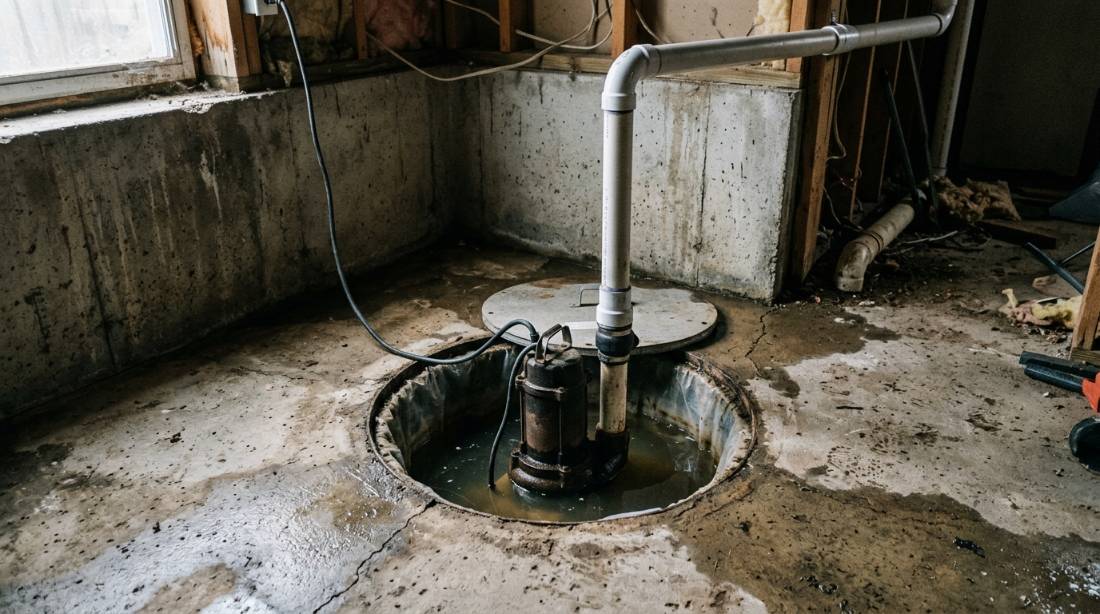
Sump pump repair & installation
The one appliance nobody checks until the basement is wet
A sump pump sits in a hole in the floor doing nothing for months, and then has to work perfectly for six hours during a spring storm. Most failures are discovered at exactly the wrong moment. Testing, repair, correct sizing, check valves and backup power, before the water table makes the decision for you.
Statewide. Storm-season call volume is heavy, earlier in the week is easier.
Symptoms
What a pump tells you before it quits
Pumps rarely die silently. They give warning in noise, cycling and smell, and almost nobody is in the basement to hear it.
It runs and runs
A pump that cycles every couple of minutes in dry weather is either fighting a stuck check valve, sitting in an undersized pit, or dealing with groundwater it was never specified for. Continuous cycling burns motors fast.
It hums but moves nothing
Power is reaching the motor and the impeller is not turning, jammed with gravel, seized after a long dry spell, or the shaft coupling has gone. This is the classic storm-night failure.
Rattling and slamming
A loud clack after each cycle is usually the check valve, and vibration against the pit wall wears through a discharge line over time. Noise is cheap to fix and expensive to ignore.
Standing water in the pit
Water sitting above the float with the pump quiet means a failed switch, a tripped GFCI, or a pump that lost its prime. If the pit smells, the sump may be taking waste water it should not be.
Storm forecast and an untested pump? Two minutes of checking now beats a wet-vac weekend.
Book a Pump CheckDo this before you call
The bucket test, done properly
Look before you pour
Lift the lid. The pit should be clear of gravel, silt and debris, the float free to swing, and the discharge pipe firmly supported. Half of all pump failures are visible at this stage without any tools.
Pour water in, not down the drain
Slowly add five gallons of clean water into the pit until the float lifts. The pump should start promptly, empty the pit and shut off cleanly. Do not simply lift the float by hand, that tests the switch, not the pump.
Watch where it goes
Go outside and confirm water is actually discharging, well away from the foundation. A pump can run perfectly and still flood a basement if the line is frozen, crushed, disconnected under the yard, or dumping four feet from the wall.
Bring this to the call
Whether the pump ran, whether it emptied the pit, how often it cycles in wet weather, how old it is, and where the discharge ends up. That is most of the diagnosis before anyone arrives.
One further check worth doing while the lid is off: find out whether the pump is on its own dedicated circuit. Sharing a circuit with a freezer or a workshop outlet means one tripped breaker takes out both, and the tripped breaker is usually discovered days later.
The work
Repair, replace, or resize
Not every failing pump needs replacing, and not every working pump is adequate. The judgement is about matching the pump to what the ground actually delivers in a bad week, rather than to what was installed when the house was built.
Switch and float faults
The most frequent single failure. Tethered floats snag on pit walls and cords; vertical floats stick with silt. Replacing a switch on an otherwise sound pump is a modest job and buys years, provided the pump body itself is not near the end of its life.
Check valve and discharge
Without a working check valve, the column of water in the discharge line falls back into the pit after every cycle, so the pump immediately runs again. It is a small part with a large effect on how many hours a motor accumulates in a season.
Sizing and pit condition
Capacity is not just horsepower, it is flow at the actual vertical lift plus friction in the run. A pit too shallow or too narrow forces short, frequent cycles that wear a pump out regardless of its rating. Sometimes the honest answer is a larger pit.
Backup that works when the power does not
Kentucky storms take out the grid and fill the pit in the same hour. A battery backup pump on its own float, or a water-powered backup on municipal supply, is the only thing that covers that overlap. A generator you have to go outside and start is not a plan.
Almost every flooded basement we hear about had a pump in it. The pump was just older, smaller, or unpowered at the moment it mattered.
Primary pump plus a backup. Specified for your pit and your lift, not off a shelf.
Talk to a Pro TodayKentucky specifics
Why pits fill here
Rainfall, river valleys and the way Kentucky basements were built all conspire to keep the pump busy.
Spring rain
Weeks of saturated ground
The Ohio Valley pattern of long, repeated spring rain does not drain, it saturates. Ground that has been wet for a fortnight puts steady hydrostatic pressure against the footing, and the pit fills continuously rather than in bursts.
A pump that copes with a thunderstorm can still be overwhelmed by ten days of steady rain and a rising water table.
River valleys
Ohio and Kentucky river towns
Along the river corridors and the low ground in Louisville, Northern Kentucky and the Ashland area, the water table sits high enough that pits run year-round in some houses. That is a duty cycle, not an emergency.
Year-round running means wear-out is scheduled, not random. Those houses want a spare pump on the shelf.
Old basements
Block walls and no interior drain
A great many Kentucky basements predate perimeter drainage entirely. Water arrives through the cove joint and through block cores rather than into a proper drain tile, so the pit only sees part of the water.
That is when the conversation widens from the pump to interior drainage, and it is worth having before finishing a basement.
Block or poured, finished or not, pit depth and how often it runs.
Related work
What the pump is protecting against, and what else fills a basement.
Questions
Sump pumps, answered straight
Roughly seven to ten years for a decent pedestal or submersible unit in normal service, and considerably less in a house where the pit runs most of the year. Age alone is a reason to test rather than to replace, but a pump past a decade in a wet basement is living on borrowed time and should not be the only line of defence.
Twice a year is the sensible rhythm, once in late winter before the spring rain, once in autumn. Pour five gallons of water into the pit and confirm the pump starts, empties it and stops. Also confirm the water is leaving the discharge outside, which is the step most people skip.
Yes, and it is usually fixable. The common causes are a failed check valve letting water fall back into the pit after each cycle, a float stuck partly open, a pit that is too small for the inflow, or groundwater genuinely arriving that fast. Short-cycling is the fastest way to wear a motor out.
If a wet basement would cost you anything you care about, yes. Kentucky storms routinely knock out power at the same moment they fill the pit, which is precisely when a mains-only pump becomes an ornament. A battery unit on its own float takes over automatically and buys hours, sometimes a day.
It can, and it is a common January failure. A line that runs a long way across the yard at a shallow grade, or that terminates in a low spot where water pools, will ice up and back the pump against a solid plug. Correct fall, a freeform discharge point and keeping the outlet clear of leaves all matter.
Almost certainly not, and in most Kentucky jurisdictions it is prohibited. Sending groundwater into the sanitary sewer overloads the system in exactly the storms that cause backups, and utilities do enforce it. The discharge belongs outside, away from the foundation, or into a storm connection where one is permitted.
A dry pit smells because the trap has evaporated or because silt in the bottom has gone anaerobic. A pit that smells of sewage is a different matter entirely, it may be receiving waste water it should not be, and that is worth investigating rather than covering with a sealed lid.
In a basement that runs year-round, no. Two pumps in one pit, staged at different heights, means the second one only starts when the first cannot keep up or has failed, and it tells you something is wrong while there is still time to act.
A pump you have not tested is a pump you do not have
Two minutes of water in the pit tells you where you stand. If it fails the test, we can have someone out.