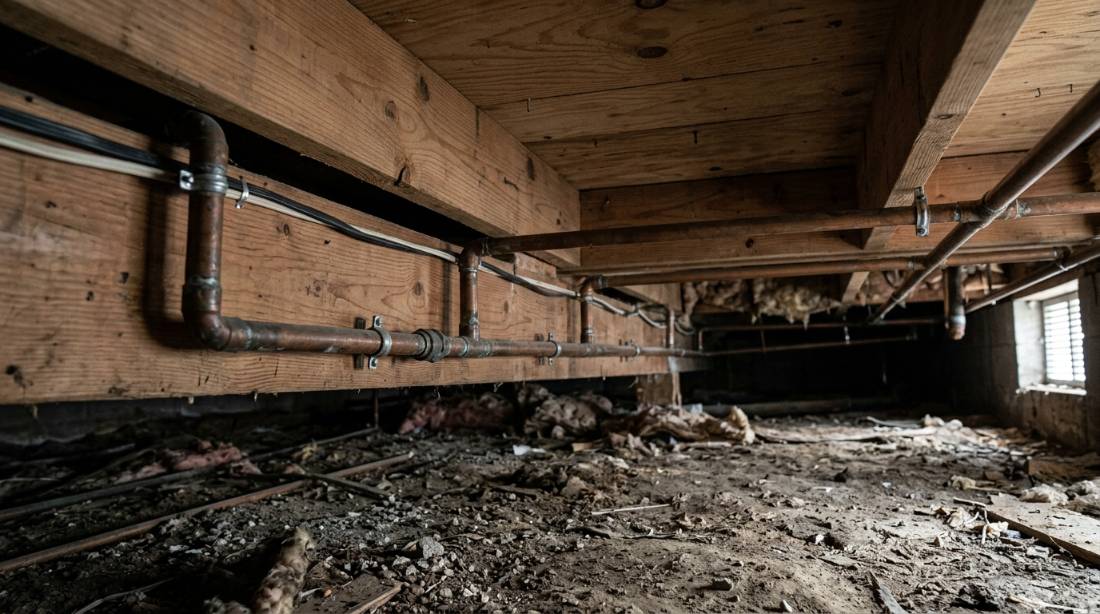
Crawl space plumbing repair
The part of your house you never look at, where most of the plumbing lives
Kentucky has an enormous number of houses sitting over vented crawl spaces, and those crawl spaces contain the supply lines, the drain runs, the insulation and the humidity. Nearly everything that fails quietly for weeks, fails down there.
Tell us the access on the call, clearance, hatch size, whether it is wet.
The setting
An unheated, humid, unvisited room with all your pipes in it
Describe a crawl space in those terms and its problems stop being surprising. In winter it is at or near outside temperature, with wind moving through the foundation vents, and the least protected length of supply pipe in the building runs through it. In summer it is cool and damp, so humid air condenses on ductwork and cold pipes, and bare soil evaporates moisture into the joists continuously.
And nobody is ever in there. A basement leak gets noticed within days because people walk past it. The equivalent leak under a floor gets noticed when the water bill arrives, when a smell reaches a register, or when someone finally opens the hatch for an unrelated reason.
So crawl-space work divides into two jobs that should be done together: fix the plumbing fault, and address the conditions that hid it and helped cause it. Doing only the first is why the same pipe gets repaired twice.
Worth knowing before you call
Clearance height, hatch location and size, whether there is standing water, and whether power is available nearby. Those four answers determine who we send and what they bring.
Never had it inspected? That is reason enough for a first look.
Book an InspectionWhat turns up
Six findings, in rough order of frequency
This is what a pro actually reports after an hour under a Kentucky house.
Weeping supply joints
A slow drip at a fitting rather than a dramatic split. Enough to soak insulation and darken a joist, not enough to affect pressure upstairs. Often years old by the time it is found.
Sagging drain runs
A failed hanger lets a length of waste pipe belly downward, so water stands in it instead of flowing. Produces recurring slow drains, odour, and a section that freezes first in a cold snap.
Frozen or previously frozen supply
Uninsulated or badly insulated runs crossing the space, sometimes with heat tape that stopped working several winters ago. The same length freezes every hard winter.
Failed insulation and vapour barrier
Batts hanging out of the joists, torn or absent ground sheeting, and standing humidity. Not glamorous, but it is what keeps everything else wet and hidden.
Old material at the end of its life
Galvanized supply choked with rust, cast-iron waste scaled and cracking, or grey polybutylene that has begun failing at the fittings. These are system conversations, not spot repairs.
Damage and interference
Rodent-chewed insulation and wiring, pipes resting on ductwork or dirt, previous repairs supported by whatever was to hand. Common in properties with long gaps between inspections.
Any of that sound like your house? Most of it is cheap to fix and expensive to ignore.
Ask About a Crawl Space VisitThe work
Repair in place, or replace the run overhead
Two genuinely different approaches, and the right one depends on what the pipe is and how many times it has failed. A spot repair is quick and correct for an isolated fault in sound material, cut out, replace the section, re-support properly, insulate over the repair. A pro doing that well leaves the pipe better supported than it was, because a repair that hangs on the same failed hanger is a repeat visit.
Replacement is the conversation when the material is the problem. Rerouting supply in PEX, run continuously with fewer fittings, hung correctly and insulated as a system, removes an entire class of future calls. In some houses that means bringing the run up into conditioned space and out of the crawl space entirely, which is the only permanent answer to a length that freezes every winter.
On the waste side, the equivalent decision is between rehanging a sagged run and replacing it. Pitch is not negotiable, a drain either falls consistently or it does not work properly, so a run with several sags and old cast iron in it is usually better replaced than adjusted.
- Support at proper intervals, in hangers appropriate to the pipe material, not wire and improvisation.
- Insulation as a continuous system, through hangers and around fittings, not in interrupted lengths.
- Nothing resting on soil or ductwork, because contact is where corrosion and condensation concentrate.
- Wet insulation removed, not dried in place, and the vapour barrier repaired while somebody is down there.
Price given on site once the access and the extent are known.
The other half of the job
Fixing the pipe without fixing the space is half a repair
Establish where the water comes from
Plumbing leak, ground moisture, or surface water after rain, they look similar down there and need different trades. Continuous and clean points at plumbing; weather-correlated and at the perimeter points elsewhere.
Deal with the ground
An intact vapour barrier over the soil is the highest-value improvement in most Kentucky crawl spaces. It cuts the humidity that condenses on pipes and ducts and keeps the structure dry enough that the next leak is actually visible.
Then decide about the vents
Covered in winter to keep wind off the pipework; the summer approach depends on whether the space is ventilated or sealed and conditioned. Sealing a damp space without addressing the moisture makes things worse, so this is a decision, not a default.
Related work
Finding what is leaking under there, and stopping it happening again next winter.
Questions
Crawl spaces, answered straight
Because that is where the pipes are, and because nobody goes down there. A vented crawl space is unheated, humid in summer, windy in winter and out of sight, so a supply line freezes or a drain joint weeps for weeks without anyone upstairs noticing. Access is the difference: a basement leak announces itself, a crawl space leak does not.
A musty smell at floor level or from floor registers, a floor that feels cooler or springier in one area, a water bill that rose without explanation, condensation on ductwork, or insulation that has dropped out of the joists. Any of those is worth an inspection. So is simply never having looked.
Individual repairs are perfectly normal, a failed section, a weeping joint, a cracked fitting. What changes the calculation is repetition. If a pro is under there for the third time in two years on the same galvanized or polybutylene system, replacing the run in PEX, properly supported and insulated, costs less over any sensible horizon than the visits do.
Wet fibreglass batts hold water against joists and subfloor for months and never recover their value, so yes, remove and replace rather than leave and hope. It is also the moment to check whether the vapour barrier on the ground is intact, because that is often as much of the moisture story as the leak was.
It is a heavy plastic sheet over the ground that stops soil moisture evaporating up into the space and into the structure. In most Kentucky crawl spaces it is the single highest-value improvement, because bare soil under a house is a permanent humidity source. Ventilation strategy and barrier work together and should be decided together rather than piecemeal.
Yes, and it is one of the most common findings. Drains work on fall, a consistent slope from fixture to main. When a hanger fails and a length of pipe sags, water pools in the belly instead of running through, which produces recurring slow drains, smells, and a section that freezes in winter. Rehanging and repitching a run fixes a symptom people have often lived with for years.
That is exactly what we ask about on the phone. Low clearance, a small hatch, standing water, wiring in the way or evidence of animals all change who is right for the job and what equipment they bring. It is better to know before somebody drives out, and we would rather tell you honestly that access needs improving than have a wasted visit.
Sometimes, and sometimes not, which is the first thing to establish. A supply leak runs continuously and often has a clean, cool, single source. Groundwater and surface water arrive after rain, come in at the perimeter, and rise and fall with the weather. Telling them apart decides whether you need a plumber, drainage work, or both.
If nobody has been under your house this decade, something is worth knowing
One inspection, an honest list, and a price before anything gets done.