Pipe insulation & freeze protection
The cheapest plumbing work of the year happens in October
Every burst-pipe call we take in January was preventable in autumn, usually for a fraction of the cost and without anybody standing in water. Insulation, heat tape where insulation is not enough, vents covered, hoses off, and one honest look at which runs are genuinely exposed.
Same phone number as the emergencies. This one you get to schedule.
One hour, once a year
What gets done, in order
Find the exposed runs
A walk through the crawl space or basement, the garage, any utility room and the exterior walls, identifying the lengths that actually leave heated space. Insulating everything is a waste; insulating the right four lengths is the job.
Insulate properly, not approximately
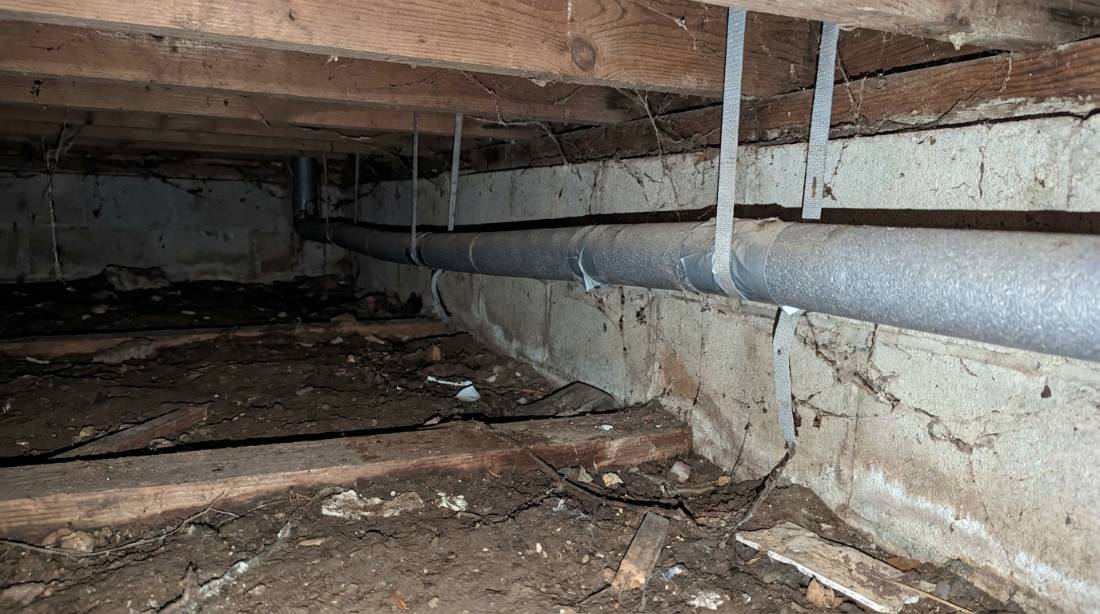
Correct internal diameter so the sleeve grips the pipe, seams taped, continuous through hangers and around elbows rather than stopping either side of them. Gaps are where ice forms, so the detail is the whole point.
Heat where heat is needed
Self-regulating heat tape on the runs that insulation alone will not save, fitted to the manufacturer's spacing, insulated over, on a grounded dedicated circuit. Existing tape gets tested rather than assumed.
Close the house down for winter
Hoses off and bibs drained, crawl-space vents covered, access hatch checked, and the shutoff located and freed so it will actually turn in February. That last one matters more than people expect.
Had a pipe freeze last winter? Same pipe, same result, unless something changes. Get it looked at now.
Get It Sorted Before the ColdWhere the risk lives
Four zones in a Kentucky house, ranked
Freeze risk is not spread evenly through a building. It concentrates in a small number of predictable places.
Vented crawl space
The default under a great many Kentucky houses and the number one location for a frozen supply line. Wind through an open vent on the windward side does more damage than air temperature alone. Sleeve everything, cover the vents, check the hatch.
Attached garage
An unheated room with plumbing in it, usually feeding a laundry or utility sink, and often with a door that gets left open. Insulate the runs and consider tape on anything against an exterior wall.
Exterior wall cavities
Supply lines routed on the cold side of the insulation, classically under a kitchen window on a north or west wall. Hard to insulate after the fact, sometimes the honest answer is rerouting the run into an interior wall.
Unconditioned attics
Less common for supply in Kentucky than in the South, but it happens, particularly with later additions and second-floor bathrooms. When it freezes up there, the water comes down through ceilings.
Read this before buying foam
Insulation slows heat loss. It does not add heat.
This is the single most useful thing to understand about freeze protection, and it explains every case where somebody insulated a pipe and it froze anyway. A foam sleeve is a delay, not a barrier. It buys hours, and in a mild Kentucky cold snap hours are plenty. In a three-day hard freeze on a genuinely exposed run, the pipe reaches the temperature of the space around it regardless of what is wrapped around it.
So the sequence of thinking runs: is this run exposed to outside air, and for how long. If briefly, insulate. If persistently, insulate and add a heat source, or change the exposure, cover the vents, seal the wind path, or reroute the pipe into conditioned space. Choosing between those is what an experienced eye is for.
The corollary is worth knowing too. Insulating a pipe in an unheated space makes it colder in the long run, not warmer, because you have also insulated it from whatever residual warmth was reaching it. On a run with heat tape that is exactly what you want. On a run relying on drift heat from a basement, it is not.
If a run froze last winter with insulation on it, the answer is not more insulation. The answer is heat or a different route.
Assessed on site, per run, rather than sold by the metre.
Through the year
Freeze protection is an autumn job with a spring appendix
September, plan
Look at what froze or nearly froze last winter and decide whether it is an insulation problem, a wind problem or a routing problem. This is the only month of the year when that decision is unhurried.
October, do it
Insulate, tape, cover vents, disconnect hoses, drain and shut off exterior bibs, test any existing heat tape, and make sure the main shutoff turns. A single visit covers all of it.
January, verify
During the first real cold snap, check the runs you were worried about and confirm the tape is drawing power. Finding a failed thermostat while everything still works is a good outcome.
March, undo
Vents uncovered if the crawl space relies on ventilation for summer moisture, bibs reconnected and checked for a split that happened quietly in December, and a look for anything that wept without being noticed.
Somewhere in the middle of that calendar? Whatever month it is, there is a version of this job worth doing.
Schedule a VisitRelated work
What happens when prevention did not happen, and where the vulnerable runs usually are.
Questions
Freeze protection, answered straight
October, or any mild weekend before the first hard freeze. Everything on this page is cheap, unhurried and available in daylight in autumn, and every item becomes an emergency call-out at a premium rate once the temperature drops. It is the single best-value plumbing visit in the Kentucky calendar.
In a mildly cool space, on a run that has never frozen, usually yes. Insulation slows heat loss; it does not add heat. So on a run that is genuinely exposed, a crawl space with wind moving through it, an uninsulated garage wall, a long length with no warm building around it, sleeve alone can simply delay the freeze rather than prevent it. That is where heat tape or rerouting comes in.
The right product for the pipe material, fitted along the pipe rather than spiralled tighter than the instructions allow, insulation over the top of it, and a dedicated grounded circuit, never an extension cord. It also needs looking at every autumn: tape degrades, thermostats fail, and a length that worked for six winters is not guaranteed for the seventh.
Covering vents through the cold months keeps a great deal of wind off the pipework and is standard practice in much of Kentucky. It interacts with moisture management, though, a crawl space needs either ventilation or a proper vapour barrier and conditioning, not neither. If your crawl space is damp in summer, get that assessed at the same time rather than sealing a wet space.
Disconnect every hose in autumn. A hose left attached traps water in the bib and the length of pipe behind it, which is then the coldest water in the house. If a bib has frozen before, a frost-proof replacement moves the working valve inside the heated envelope and largely solves it, provided the hose still comes off.
Either keep it heated with a reliable minimum setting and someone checking, or have it properly winterised: water off at the main, system drained down, water heater drained and switched off, traps protected. A partially heated, partially drained empty house is the worst of both and the source of a lot of February phone calls.
Two useful side effects. Insulated hot-water runs deliver hot water sooner and lose less heat on the way, which you notice most on a long run to a far bathroom. And insulated cold lines stop sweating in humid weather, which matters in crawl spaces where the drips get blamed on a leak that does not exist.
That is exactly what the visit is for. A pro walks the crawl space or basement, the garage, the utility areas and the exterior walls, and identifies the runs that are actually exposed rather than insulating everything indiscriminately. Usually it is a handful of specific lengths, and knowing which ones is most of the value.
Book the boring visit instead of the expensive one
An hour in October against a burst pipe in January is not a close comparison.