Frozen pipe repair
No water this morning? The ice is somewhere predictable, and it may already have split the pipe.
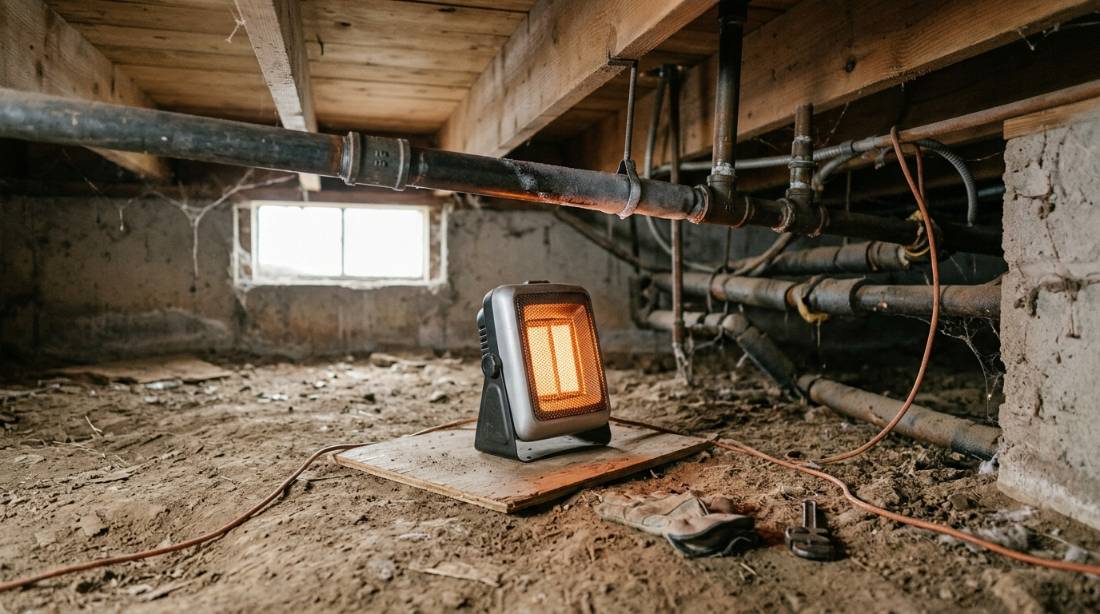
A frozen line in a Kentucky house is rarely a mystery. It is in the crawl space, the garage wall, an exterior cavity or the last few feet before an outside tap. The urgent part is not the ice, it is finding out whether the pipe survived it before the thaw finds out for you.
Twenty-four hours through every cold snap, statewide.
The mechanism
Ice does not push outward. It pushes along the pipe.
The intuition that a freezing pipe swells until it bursts is wrong, and the correct version explains everything about the timing. Ice forms a plug across the bore. Water continues to freeze onto that plug and the plug lengthens, and because a closed plumbing system has nowhere to give, pressure builds in the trapped column of water between the ice and the nearest closed valve.
The pipe then fails at its weakest point, which is often not where the ice is. Copper opens as a lengthwise split. CPVC cracks. PEX stretches and sometimes survives entirely. And crucially, nothing leaks while it is frozen, the ice is its own plug.
Then the sun comes out. The run thaws, water finds the split at full mains pressure, and the flood starts on a mild afternoon while the house is empty. That sequence is why frozen-pipe calls and burst-pipe calls in Kentucky arrive a day apart from the same weather event.
The one thing to do before thawing anything
Close the main shutoff first. If the pipe has already split, thawing it with the water on turns a frozen pipe into an indoor hose. Thaw with the water off, then restore pressure slowly while watching the run.
Water off and still no flow? That is the call to make now, not after breakfast.
Get a Plumber OutUsual suspects
Where it freezes, in the order we find it
Four locations account for the large majority of frozen lines in Kentucky housing. If you have no water at one fixture, start here.
The crawl space
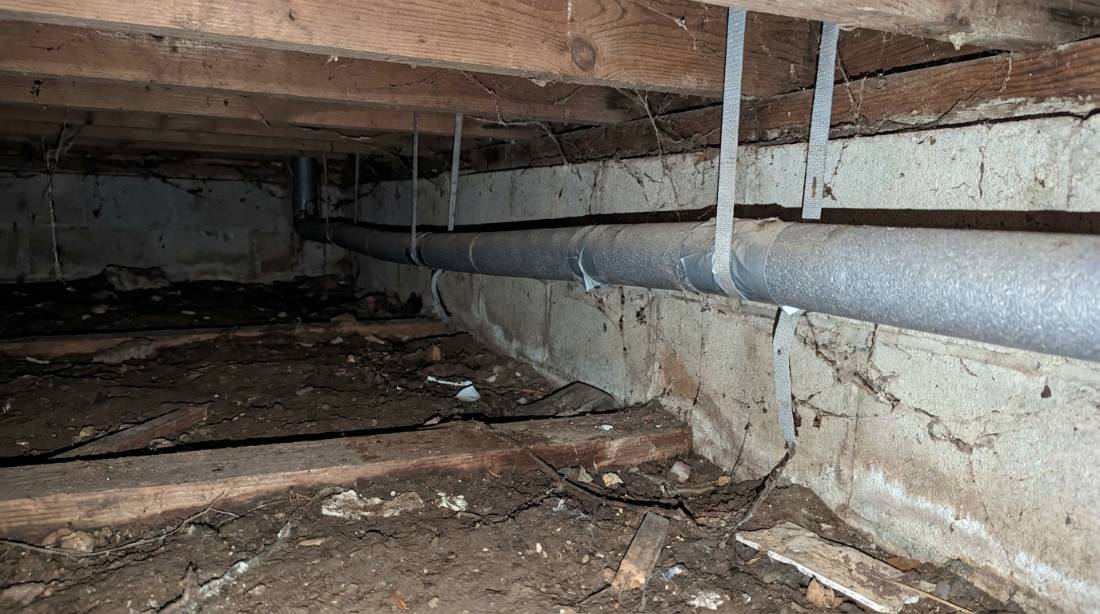
Vented, unheated, and directly under the floor, the single most common place a Kentucky supply line freezes. An open foundation vent on the windward side turns a mild night into a hard one under there.
Garage and utility walls
An attached garage is an unheated room with plumbing running through it, often to a laundry or a utility sink. A door left open on a cold evening is enough.
Exterior wall cavities
A supply run on the north or west side with insulation on the wrong side of it. Kitchen sinks under a window are a classic, and they fail again every few winters until the routing changes.
Hose bibs and the last few feet
An outdoor tap with a hose still attached cannot drain, so the water sits in the coldest length of pipe in the house. The split is often inside the wall behind the bib, not at the bib itself.
Recognise the spot? Tell us which one and we will send someone equipped for it, crawl-space work needs the right kit.
Describe It To UsNarrowing it down
Finding the ice without opening a wall
Map what still works
Open every tap in the house and note which have flow, hot and cold separately. The frozen run is upstream of the dead fixtures and downstream of the working ones, that alone usually narrows it to one wall or one length of crawl space.
Follow the cold
Trace that run to wherever it leaves heated space. Frost or beads on the outside of the pipe, a section noticeably colder to the hand, a crawl-space vent with wind coming through it, the ice is usually within a few feet of the coldest thing you find.
Check for damage before pressure
With the main closed, look along the whole exposed run for a raised seam, a hairline split or a fitting that has moved. This is the step people skip, and it is the one that decides whether the thaw is a relief or a flood.
Please do not
Three ways a frozen pipe becomes a much worse night
Every winter we get called out to the consequences of these rather than to the original freeze.
Open flame
A torch on a frozen pipe
It boils the trapped water into steam inside a closed section, which is a far more violent failure than the ice was ever going to cause. On top of that, most frozen runs sit against joists, subfloor and old insulation in a crawl space.
Crawl-space fires started while thawing pipes are a real and annual event. No exceptions to this one, including "just for a second".
Full pressure
Thawing with the main wide open
If the pipe split while frozen, and you cannot know that it did not, the moment the plug releases you have mains pressure feeding an open pipe inside your house, usually somewhere you are not standing.
Thaw with the water off and a tap open. Restore pressure afterwards, slowly, while looking at the run.
Salt and guesswork
Chemicals down a frozen drain
A frozen waste line is not a clog, and drain chemicals will not thaw it. What they will do is sit in the pipe as a caustic pool for somebody to meet later, and damage older cast iron or ageing plastic while they wait.
Warmth and patience thaw drains. Chemistry does not.
Controlled thawing, then a pressure check on the whole run.
Afterwards
The repair, and then the reason
Once flow is back, the visit divides into two halves. The first is mechanical: pressure the system, walk the whole run, and deal with what shows up. A freeze split gets cut back past the visible damage in both directions and replaced in copper or PEX; a weeping solder joint that has been worked loose by the same event gets remade rather than tightened and hoped for.
The second half is the part that actually saves you money, and it is a conversation rather than a repair. Some runs freeze because a vent is missing a cover or a garage door was left open, cheap, behavioural, done. Others freeze because the pipe should never have been routed through that cavity, and no amount of insulation will fix a fundamentally exposed run. Rerouting a short length into heated space costs more once and nothing thereafter.
- Insulation that actually fits: the correct internal diameter, taped at the seams, continuous through hangers rather than stopping either side of them.
- Heat tape where insulation is not enough: on the pipe, under the insulation, on a dedicated circuit, and inspected each autumn rather than assumed.
- Crawl-space air sealing: vent covers for winter and a look at the access hatch. It is remarkable how much of a freeze problem is wind.
- Frost-proof hose bibs: the valve seat sits inside the heated envelope, so the vulnerable water is never in the cold length. Only works if the hose comes off in autumn.
If a pipe froze last winter and nothing has changed about it since, it is the pipe that will freeze this winter. October is the cheap month to deal with that.
Same pipe, second winter? Ask for the routing to be looked at, not just the ice cleared.
Book a Proper LookRelated work
Thawing, the split that follows, and getting ahead of next January.
Questions
Frozen pipes, answered straight
The tell is one fixture, or one side of the house, going dry while the rest still runs, and it happening on the coldest morning of the week. Frost or condensation on an exposed run, a faucet that gives a trickle then nothing, and a toilet that will not refill all point the same way. If nothing in the house has water and the temperature is mild, suspect the service line or the pump instead.
It is urgent, yes. A frozen run is either already split or under stress, and you do not find out which until it thaws. Getting it thawed under supervision, with the water off at the main and somebody watching the pipe as flow returns, is far better than discovering the split when it lets go into a ceiling while you are out.
On an accessible, visible run, gentle heat applied from the fixture end and worked slowly back toward the frozen section is reasonable. Never use an open flame, a propane torch or a heat gun on full, that is how frozen pipes become burst pipes and how crawl spaces catch fire. If the pipe is inside a wall, under a floor or you cannot see where the ice is, call.
Because freezing is about exposure, not about the whole house. A run crossing an unheated crawl space, sitting in an exterior wall cavity with no insulation behind it, passing through a garage, or feeding a hose bib has a very different night from a pipe in a heated interior wall. The same one usually freezes every hard winter until something about its insulation or routing changes.
A slow trickle at the fixture furthest along the most exposed run does help, because moving water freezes later than still water and an open tap gives expanding ice somewhere to push. It is a stopgap, not a fix, and it does nothing for a run that is already blocked with ice upstream of the tap.
Restoring flow is step one; step two is inspecting the whole run under pressure for splits and weeping joints. If it split, the damaged length gets cut back past the visible crack in both directions and replaced. Then the real question: why this pipe, and what needs insulating, rerouting or heat-taping so that January does not repeat itself.
Almost always, unless someone changes the conditions. If a run froze last winter and nothing has been done to it since, it is the run that will freeze again this year. That is the strongest argument for dealing with it in October rather than at three in the morning in a cold snap.
We cover them, and we will be straight with you about what the weather allows. Ice on a steep gravel drive is a real constraint on when a truck can safely get to a property, and pretending otherwise wastes your evening. You will get an honest window and, if it is first light rather than tonight, practical instructions for the interim.
Do not wait for the thaw to tell you whether it split
Water off, pipe thawed under supervision, whole run checked under pressure. Any hour, any Kentucky community.