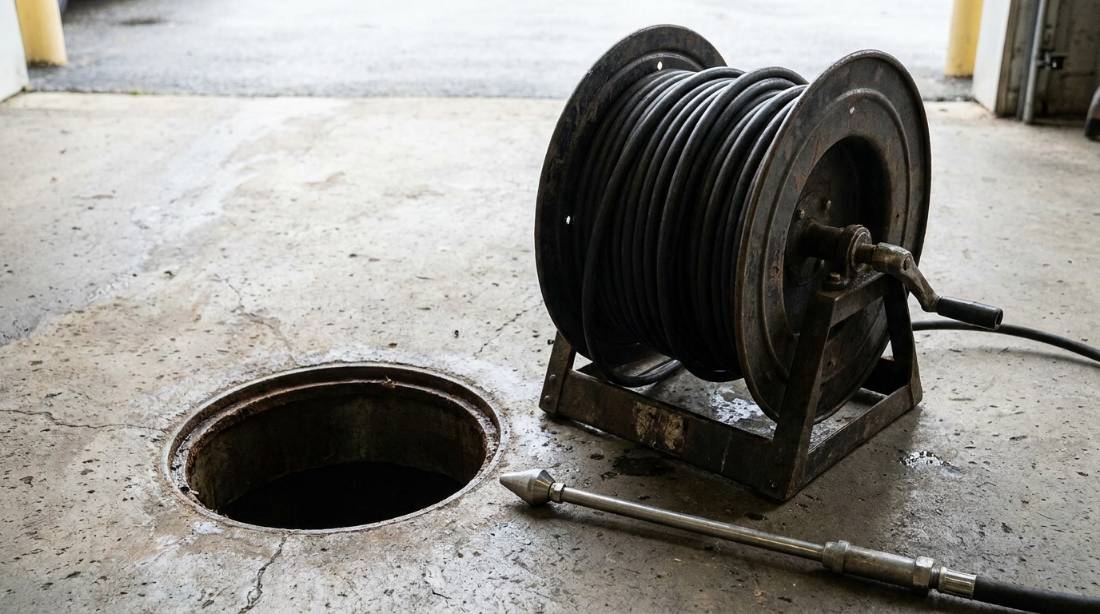
Hydro jetting
A cable makes a hole. A jet cleans the pipe.
When a line blocks repeatedly, the problem usually is not the thing that blocked it, it is the coating of grease and scale on the pipe wall that has been narrowing the bore for years. High-pressure water scours that back to the original diameter. Used on the right pipe, it is the difference between a fix and a subscription.
Statewide. Camera inspection first, always, on any line with unknown condition.
The right job
Where a jet earns its keep
Jetting is not a universal upgrade over cabling. It is decisively better in four specific situations.
Grease in a kitchen line
A cable bores through congealed grease and leaves the walls coated, so it re-blocks in weeks. Hot high-pressure water emulsifies and flushes it out entirely. This is the single most common justification.
Scale and build-up
Years of hard-water mineral and soap deposit narrowing a waste line. A jet with the right nozzle strips it back to the pipe wall, restoring a bore that no cable can recover.
Roots, after cutting
Cabling cuts a root mat; jetting flushes the debris out and washes the joint clean, which slows regrowth. Neither ends the problem permanently, the pipe repair does, but the pair buys considerably longer than a cable alone.
Commercial and restaurant lines
Kitchens, laundries and multi-unit buildings put volumes of grease and solids through lines that were never sized for it. Scheduled jetting is genuinely preventive maintenance in that setting, not a repair.
Same line, third blockage? Cabling it again is the expensive option.
Book Jetting with a CameraOn the day
How a jetting visit runs
Camera first, without exception
The line is inspected before any pressure goes into it. The camera establishes pipe material, condition and whether there is a crack, an open joint or a bellied section. Jetting a pipe that is already broken makes a modest repair into an excavation, and no responsible operator skips this.
Access, nozzle, pressure
The hose goes in through a cleanout wherever possible. Nozzle and pressure are matched to the pipe: a forward jet to open a path, rearward jets to pull the head along and scour behind it. Cast iron, clay, PVC and Orangeburg all take different settings, and the difference matters.
Jet, then look again
The head is worked along the full length and back, flushing debris downstream to the main. The camera then goes back in to confirm the wall is clean and to record what the pipe actually looks like now, which is the record you want if the line has a history.
Ask for the second camera pass
A before-and-after view is the only proof that the line was cleaned rather than merely opened. It also documents any defect found, which is what a repair decision or an insurance conversation later rests on.
Worth being direct about cost: jetting is more expensive than cabling for a single visit. On a line that blocks once in a decade, a cable is the sensible economy. On a line that blocks every few months, the third cable has already cost more than the jet would have.
Limits
When not to jet
The honest part of this service is the list of pipes that should not see high-pressure water. Anyone who will jet anything without looking first is selling equipment time rather than judgement.
Cracked or collapsed pipe
Pressure escaping through an existing crack washes out the bedding around the pipe and turns a defect into a void. A line the camera shows as broken needs repair or lining, and jetting it first can materially increase the excavation required.
Badly corroded cast iron
A stack scaled to half its bore may also be paper-thin in places, and the scale is holding it together. Stripping that back can find a hole rather than a clean wall. Sometimes the correct recommendation after the camera is replacement rather than cleaning.
Orangeburg and fibre conduit
Bituminised fibre pipe was used widely in mid-century housing and it deforms and delaminates with age. It does not tolerate high-pressure water. Finding Orangeburg on camera generally moves the conversation straight to replacement.
Where a bellied section is the real fault
A sag holding standing water will keep collecting solids no matter how clean the pipe wall is. Jetting clears it and it refills. The fix is regrading or relining that length, and jetting only masks the symptom in between.
Every line we refuse to jet is a line where jetting would have worked exactly once, and made the eventual repair bigger.
Right tool, right pipe. The camera decides, not the truck.
Talk to a Pro TodayKentucky specifics
Why lines here coat up
Hard water and old pipe make build-up the normal condition rather than the exception.
Limestone water
Mineral on every surface
Kentucky groundwater carries a heavy mineral load, and it deposits inside waste lines as surely as it does in a water heater. Combined with soap and grease it forms a hard, rough coating that steadily reduces the effective diameter.
Jetting is one of the few methods that recovers that lost bore rather than boring through it.
Old cast iron
Rough walls catch everything
The pre-1970 housing stock across the river cities is full of cast-iron drains whose internal surface is no longer smooth. Once the wall is rough, every subsequent deposit sticks more readily than the last.
The camera decides between cleaning it and replacing it. Both are legitimate answers depending on wall thickness.
Restaurant districts
Grease at commercial volume
Older commercial buildings in Louisville, Lexington, Covington and Bowling Green frequently run kitchen waste through lines sized long before the current use. Scheduled jetting is standard practice in that world.
Interceptor service and line jetting go together, one without the other rarely holds.
Pipe material, age, and how often it blocks.
Related work
What comes before jetting, and what comes after.
Questions
Hydro jetting, answered straight
A cable is a rotating steel line with a cutting head that bores through a blockage and restores flow. A jet is high-pressure water that scours the full circumference of the pipe back to its wall. Cabling opens a path; jetting cleans the pipe. Which one you need depends on whether the problem is an obstruction or a coating.
In sound pipe, no, the pressure is matched to the material. In pipe that is already cracked, badly corroded or made of fibre conduit, it can cause real harm. That is exactly why a camera inspection comes first, and why a contractor who declines to jet a particular line is doing you a favour.
On a grease-fouled kitchen line with no structural defect, a properly jetted pipe can run for years. Where roots or a bellied section are the underlying cause, jetting buys a season or two because the defect is still there. The camera tells you which situation you are in before you spend the money.
For a one-off blockage in a sound line, usually not. For a line that has blocked repeatedly, almost always, the third or fourth cable visit typically exceeds what a single jet-and-camera would have cost, and leaves the pipe in the same condition.
It cuts fine roots and flushes out the debris left after cabling, and washing the joint clean does slow regrowth. It does not remove the reason roots are entering, which is an open joint or a crack. Treat it as effective maintenance rather than as a permanent solution.
No. The hose goes in through an existing cleanout, or through a pulled toilet or a temporary access where no cleanout exists. If your house has no accessible cleanout at all, adding one is a small job that makes every future visit cheaper and faster.
A residential lateral or kitchen line is usually a couple of hours including both camera passes. Commercial lines, long runs or heavily fouled pipe take longer. The variable is almost always how much material is coming off the wall, not the length of the pipe.
Commonly every three to six months, driven by volume and by how well the grease interceptor is maintained. The right interval is the one that stays ahead of a blockage during service, and a camera pass every so often confirms whether the schedule is right.
Stop paying to punch the same hole
If a line keeps blocking, the pipe wall is the problem. Get it looked at, then get it cleaned properly.