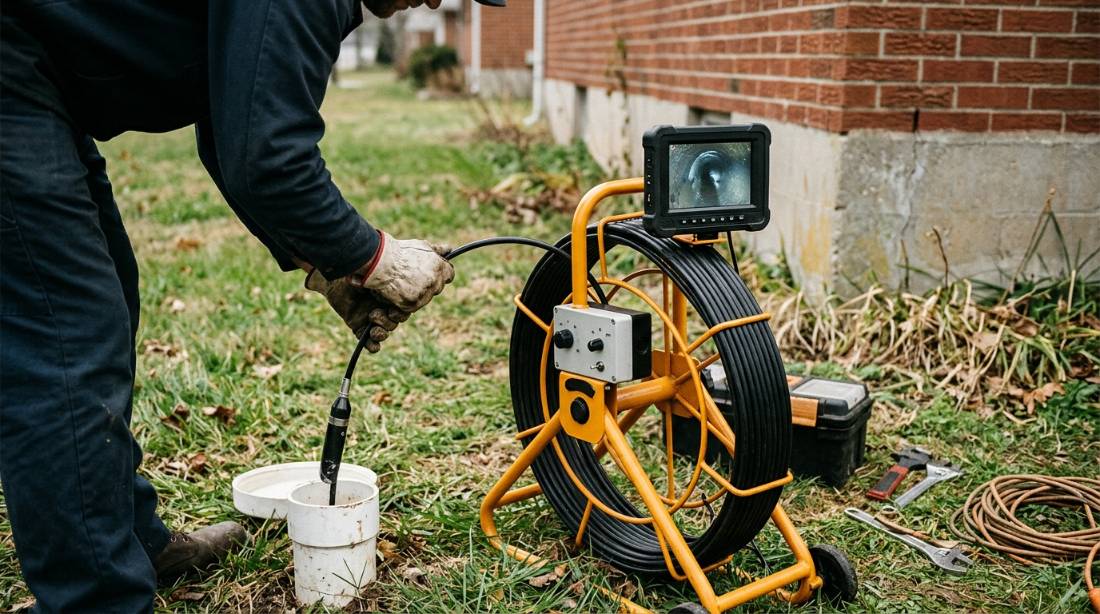
Sewer camera inspection
The cheapest hour in the whole job
Every decision about a sewer line, clear it, jet it, line it, replace it, or leave it alone, depends on what the pipe actually looks like inside. A camera answers that in an hour, marks the fault to a depth and a spot in the yard, and turns a guess about a five-figure excavation into a measured decision.
Statewide. Ask for the recording, it is your evidence, not ours.
Reasons to look
When a camera pays for itself immediately
Four situations where inspecting first reliably costs less than not inspecting.
Before buying a house
A general home inspection does not include the sewer lateral, and the lateral is one of the most expensive single components a buyer can inherit. On any Kentucky house built before 1970, this is the highest-value hour of the whole purchase.
A line that keeps blocking
Recurrence means a cause, and the cause is in the pipe. Cabling a line for the third time without looking at it is the definition of paying twice for the same information.
After a backup
Once flow is restored, the camera settles whether it was a one-off or the pipe is failing, and whether the fault sits on your side of the connection or the utility’s.
Before spending real money
Nobody should authorise an excavation, a liner or a repipe on a guess. The camera locates the fault, gives its depth, and defines the length of pipe actually involved.
Under contract on an older house? Get the lateral looked at before the inspection period closes.
Book a Pre-Purchase ScanOn the day
What actually happens
Find or make an access point
A cleanout is ideal. Where there is none, access is through a pulled toilet or a roof vent, both routine. If your house has no accessible cleanout, adding one is worth discussing, every future visit to that line is cheaper with one.
Run the camera the full length
A self-levelling head on a push rod travels the lateral to the main connection, with distance counted the whole way. The operator narrates what is on screen: material changes, joints, roots, scale, standing water, cracks. Watch it with them, the running commentary is most of the value.
Locate and mark the fault
A transmitter in the camera head lets a locator above ground fix the position and depth of any defect, which gets marked on the surface. That mark is what turns a repair quote from an estimate into a scope, and it is what keeps an excavation to a few feet instead of a trench.
Ask for the footage before you pay
A recording with distances, plus the located depth and position of any defect, is a deliverable you own. Take it to any contractor for a second opinion. A refusal to hand it over is a reason to hire somebody else.
A caveat: a line packed with grease or standing water may need clearing before the camera can see anything useful. That is why clearing and inspecting are often quoted together, and why the camera pass usually happens immediately after the cable comes out.
What it finds
The five things the camera is looking for
A sewer inspection is not a general look around. The operator is checking for a specific short list, because those five findings are what determine every subsequent decision.
Root intrusion
Fine roots at a joint, or a mat filling the bore. The camera shows how many joints are affected and how far along the run, which is the difference between cutting one intrusion and lining thirty feet of pipe.
Cracks, breaks and offsets
Longitudinal cracking, a shear break, or a joint where two lengths no longer line up. An offset joint catches solids permanently and is a common reason a line blocks in the same spot forever.
Bellies and standing water
A sagging section where the pipe has lost its fall, holding water between blockages. It shows on camera as water that never drains as the head advances. Cleaning never fixes it, regrading or relining does.
Scale, grease and reduced bore
How much diameter has actually been lost. This is what separates a line that should be jetted from a line that is past cleaning, and it is impossible to judge from the fixture end.
Pipe material and vintage
Clay, cast iron, Orangeburg, concrete, PVC, often more than one in the same run. Finding Orangeburg or heavily corroded cast iron changes the conversation immediately, because those materials fail as a matter of course rather than by accident.
An hour with a camera has stopped more unnecessary excavation than any other tool in the trade. It has also caught a great many houses about to be bought with a failing lateral.
Look first, then decide. Clearing, lining, digging, all of it depends on this.
Talk to a Pro TodayKentucky specifics
What the camera usually finds here
The state’s housing stock and ground conditions produce a fairly consistent set of findings.
Clay laterals
Joints every few feet
Vitrified clay was standard for house laterals for generations across Kentucky, and every joint is a potential root entry. In older neighborhoods a camera pass frequently shows intrusion at multiple joints along one run.
That finding is what makes lining attractive: it addresses every joint at once rather than one at a time.
Orangeburg
Mid-century fibre conduit
Used widely in post-war construction, bituminised fibre pipe deforms into an oval and delaminates with age. It cannot be cleaned or lined in any durable way, and finding it moves the discussion directly to replacement.
It is one of the clearest cases where an hour of camera work prevents money being spent on the wrong repair.
Karst ground movement
Settlement and offsets
Limestone country with dissolution and settlement produces bellied sections and offset joints in lines that were laid perfectly well. It is a ground problem showing up as a pipe problem.
Locating precisely how deep and how long the affected section is matters enormously to what the repair costs.
House age, symptom history, and whether you know where the cleanout is.
Related work
What the inspection leads to.
Questions
Camera inspections, answered straight
It is the easiest access, but not the only one. Where no cleanout exists, the camera can go in through a pulled toilet or down a roof vent. If your house has no accessible cleanout at all, installing one is a modest job that makes every future clearing and inspection faster and cheaper.
On any older Kentucky house, it is among the best value inspections available. A standard home inspection does not include the sewer lateral, and replacing one is a substantial cost that lands entirely on the new owner. Clay, cast iron and Orangeburg are all common enough here to justify looking.
Yes. The head carries a transmitter, and a locator above ground fixes its position and depth, which is then marked on the surface. That is what allows a repair to be a targeted excavation of a few feet rather than a trench along the length of the yard.
You should insist on it. A recording with distance markers, plus the located depth and position of any defect, is yours and lets you take a second opinion to another contractor. Any reluctance to provide it is a good reason to use somebody else.
Often, yes. A line full of grease, roots or standing water will not give a usable picture, so clearing usually has to happen first. That is why the two are frequently quoted together and why the camera pass follows immediately once flow is restored and access is already open.
Typically under an hour for a residential lateral with reasonable access, including the locate. Longer runs, difficult access, or a line that needs clearing first will add to it. The results are visible on the screen as it happens, so you are not waiting on a report to know the answer.
A sagging length of pipe that has lost its fall and holds standing water. Solids settle in it between uses, so the line blocks repeatedly in the same spot however often it is cleaned. It is a common finding in karst country and the fix is regrading or relining that section, not more cleaning.
Usually. The camera records the distance to the defect and the locate fixes it on the ground, which shows whether it sits within your lateral or at or beyond the connection to the public main. Responsibility varies by jurisdiction in Kentucky, but that measured position is what any conversation with a utility starts from.
Nobody should dig up a yard on a guess
An hour with a camera decides whether this is a cleaning, a liner, or a replacement.