Root intrusion removal
Cutting roots is maintenance. Sealing the joint is the repair.
Roots do not break into a sewer pipe. They find a joint that is already open, follow the moisture through, and thicken inside where conditions are perfect. Which is why cutting them out works beautifully for a season and then the line blocks again, and why the durable answer is closing the door rather than trimming what came through it.
Statewide. Camera inspection after clearing tells you whether it will come back.
Symptoms
A blockage with a calendar
Root problems have a distinctive signature: they recur, they get gradually worse, and they often follow the seasons.
It blocks about once a year
Root growth is seasonal, so a lateral with intrusion frequently backs up at roughly the same time each year. A blockage you can almost predict is a structural problem, not bad luck.
Gurgling that comes and goes
A root mat is a partial obstruction long before it is a full one. Air forced past it makes a toilet or tub bubble intermittently, often worse after heavy use.
Cleared, then worse sooner
Each clearing leaves cut root ends that regrow, and the mat re-establishes faster than before. Shortening intervals between visits is the clearest evidence of intrusion.
A big tree, an old lateral
A mature tree within about thirty feet of the run, over jointed clay or cast-iron pipe, is the classic setup. The tree does not need to be directly above the line.
Blocking on a schedule? The camera will show whether roots are the reason.
Book a Camera InspectionThe visit
Clear it, see it, then decide
Cut and restore flow
A cable with an appropriate cutting head is run through the affected length to open the bore. This is the immediate relief, and on a badly matted line it can take several passes to get a clean run to the main.
Jet out the debris
Cutting leaves fibrous material and whatever the mat had been catching. High-pressure water flushes it downstream and washes the joints clean, which measurably slows regrowth compared with cabling alone.
Camera the full run
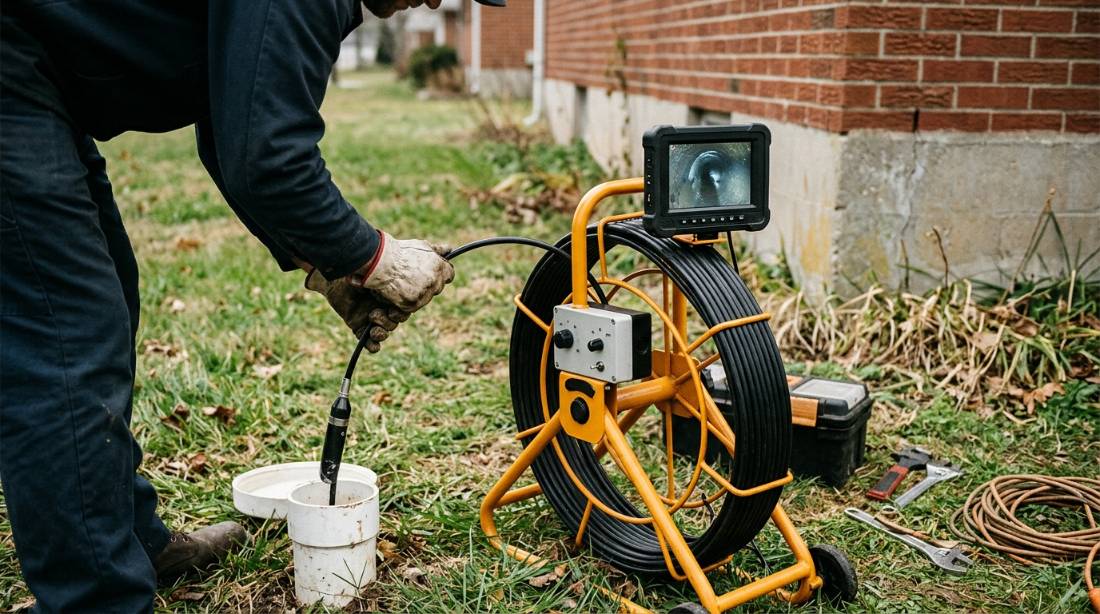
This is the step that changes the outcome. The camera shows how many joints are affected, how far along the run, whether the pipe is otherwise sound, and whether there is a crack or an offset behind the intrusion. It is the difference between planning a fix and booking the same visit again next year.
The question to ask afterwards
Not "is it clear" but "how many joints have roots in them". One intrusion in sound pipe is a spot repair candidate. Roots at joint after joint along the run means the pipe is generally open and lining it is the proportionate answer.
On chemical root killers: foaming products containing a herbicide can kill root tissue inside the pipe and slow regrowth for a while, and some plumbers use them as an adjunct after cutting. They do not remove the mass, they do not seal the joint, and they are not a substitute for finding out what the pipe looks like.
The permanent fix
You cannot out-cut a tree
Every method of removing roots leaves the opening they came through. The tree is still there, the moisture gradient is still there, and root growth is what trees do. The only durable solutions eliminate the entry point.
Lining the pipe
A cured-in-place liner forms a continuous jointless pipe inside the old one, sealing every joint along its length at once. For a clay lateral with intrusion at multiple joints, the standard Kentucky case, this is the definitive answer, and it needs pits rather than a trench.
Spot repair at a single joint
Where the camera shows one intrusion in an otherwise clean run, excavating a few feet and replacing that section is the smallest sufficient fix. It depends entirely on trusting the locate, and on the rest of the pipe genuinely being sound.
Full replacement
A line that is both root-filled and structurally failing, collapsed sections, Orangeburg, badly deteriorated clay, is past sealing. Pipe bursting replaces it along the same path from two pits; open-cut is sometimes cheaper in an open yard.
Managing the tree
Occasionally raised, rarely the answer. Removing a mature tree is expensive, slow to take effect since roots persist, and often not what the owner wants. Root barriers help at the margins. Sealing the pipe is nearly always the cheaper and more certain path, and it lets you keep the tree.
A yearly root cutting is a subscription. Priced over ten years it usually exceeds what lining the line would have cost once.
Cut now, seal later, but plan the second part.
Talk to a Pro TodayKentucky specifics
Why this is endemic here
Kentucky pairs jointed clay laterals with some of the best street-tree canopy in the country.
Clay laterals
A joint every few feet
Vitrified clay was standard for house laterals through the 1960s, joined every three to six feet with mortar or a gasket that has had decades to fail. Each joint is a candidate entry point.
A camera in an old clay run rarely finds one intrusion. It finds a pattern, and that pattern is what makes lining the sensible answer.
Mature canopy
Old neighborhoods, big trees
The Highlands and Crescent Hill in Louisville, Ashland Park and Chevy Chase in Lexington, the older river-town districts, established streets with large trees over pre-war laterals.
Silver maple, willow and sycamore are the notorious offenders, but any large tree within thirty feet is capable of it.
Dry summers
Roots go looking
A run of dry weather sends roots hunting for moisture, and a sewer lateral is a reliably warm, wet, nutrient-rich target. Intrusion often accelerates after a dry season.
Which is why a line that coped for years can start blocking after one bad summer with no other change.
How often it blocks, what time of year, and what is growing nearby.
Related work
Clearing it, and the repairs that end it.
Questions
Root intrusion, answered straight
They do not need a hole, only a joint. Clay and older cast-iron laterals are jointed every few feet, and a joint that has lost its seal releases a trace of moisture and nutrient into the soil. A hair root follows that gradient through the gap, then thickens inside the pipe where conditions are ideal.
No. Cutting restores flow and buys time, commonly a season or two, but the entry point is still open and the tree is still growing. Every clearing leaves cut ends that regrow, which is why the intervals between blockages typically get shorter rather than longer.
Almost never, and it is usually the wrong lever. Removal is expensive, the roots persist in the soil for years, and it does nothing about the open joint that other trees can also find. Sealing the pipe by lining or replacing it lets you keep the tree and ends the problem more reliably.
Partially. Foaming herbicide products kill root tissue in contact with the pipe and can slow regrowth for a period, and some plumbers use them after cutting. They do not remove the existing mass, they do not seal the joint, and they should be treated as a way of stretching the interval rather than a fix.
The camera settles it in minutes, and the pattern is suggestive on its own: recurring blockages at roughly the same time each year, gradually shortening intervals, gurgling that comes and goes, and a mature tree near the run. Grease and soft blockages behave differently.
A correctly installed cured-in-place liner has no joints for a root to enter, which is precisely why it works. The vulnerable points are the ends and any reinstated branch connections, so those details matter, ask to see the closing camera pass covering every connection on the run.
A typical residential lateral is a couple of hours to cut, jet and inspect. A heavily matted line can take several cutting passes before the head runs clean to the main. If the camera then finds a collapse behind the roots, that is a separate conversation about repair rather than clearing.
Work out ten years of clearing visits plus the risk of one backup that reaches the basement, and compare. For most households the arithmetic favours sealing the pipe well before a decade is out, and the camera tells you whether one joint or twenty are involved, which is what sets the price.
The tree is not going to stop
Cut it now if you must, but get the line inspected while access is open, that is what decides whether this repeats.