Pipe thawing
Getting the flow back without cracking the pipe on the way
Thawing is a controlled job, not a fast one. Done properly it is the cheapest winter call you can make, an intact pipe, water restored, nothing cut. Done with a torch and enthusiasm it becomes a burst pipe, a wet ceiling, or a crawl-space fire.
Close the main before anyone starts thawing. Leave one cold tap open on the affected run.
Four methods
What actually gets used, and when
The right method depends on what the pipe is made of, whether anyone can reach it, and whether it carries supply or waste. There is no single tool for all of it.
Warm air, patiently
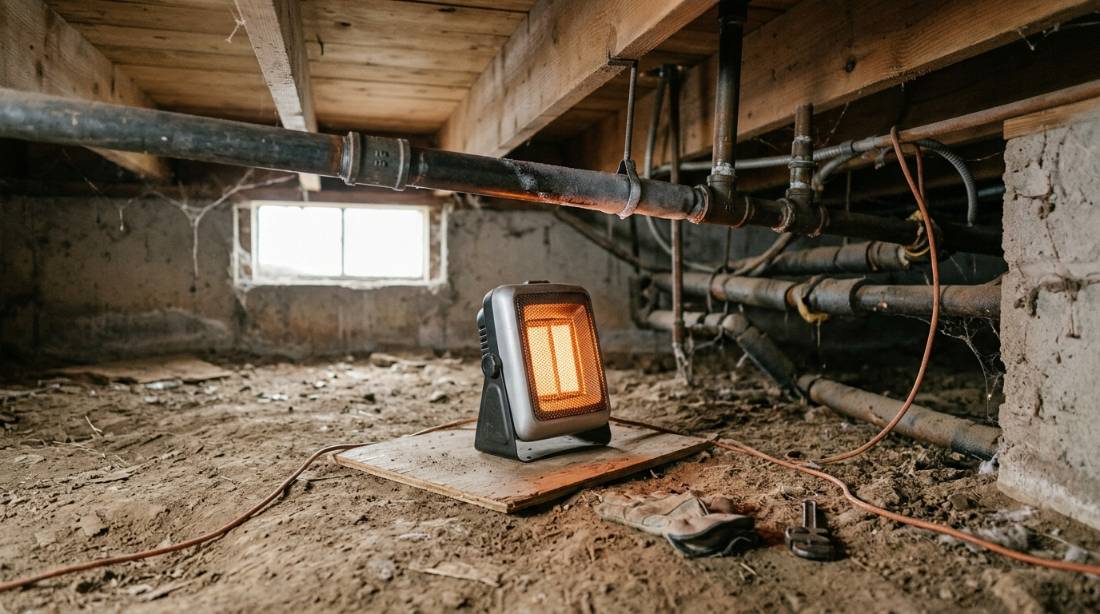
Space heaters, heat lamps or warm air fed into a cavity or a crawl space. Slow, gentle, and the safest option for plastic pipe and enclosed runs. Works from the fixture end backwards so meltwater has somewhere to escape.
Electric thawing machine
Clamps to two points on continuous metal pipe and warms the whole length between them from the inside. Clears runs nobody can physically reach. Useless across plastic sections, dielectric unions or a PEX repair.
Steam or hot-water thawing
A hose fed into the pipe delivering heat directly to the ice face. This is the standard approach for frozen drains, sewer lines and buried service runs, where the ice is long and the pipe is not reachable from outside.
Deliberate access
Sometimes the least damaging answer is one small opening in the right place, a drilled hole in a soffit, a panel out of a closet, chosen so the repair afterwards is trivial. Better a considered hole than an hour of heat on a wall.
Describe the run and the material and we will send the right kit.
Order of operations
Why thawing starts at the tap and works backwards
Heat applied to the middle of an ice plug melts water that has nowhere to go. It sits between two plugs, warms, expands and puts pressure on exactly the length of pipe you are trying to save. Start at the open fixture instead and every drop of meltwater has a clear path out, so the plug shortens from the downstream end.
That is also why an open tap matters. It is not just an indicator that flow has returned, it is the relief path for the whole process. A closed system being thawed is a closed system being pressurised.
The second rule is that heat comes off before the pipe gets hot. Warming a pipe to the point where you would not hold it does nothing useful for the ice and does real damage to plastic, to solder joints and to the seals inside nearby valves. Steady, moderate, boring warmth wins.
The thing nobody expects
When the plug lets go, it can release with force and noise. If the pipe split while frozen, this is the moment the water appears, which is exactly why the main is closed and somebody is standing there watching.
Water off, tap open, nothing happening? That is where we come in.
Call for ThawingThe other kind
Frozen drains behave nothing like frozen supply lines
A supply pipe is full of still water under pressure, so it freezes readily and splits when it does. A drain is mostly air, and it only freezes where water is standing in it, which means a frozen waste line is nearly always telling you about a fault that existed before the cold weather.
Three situations produce most of them. A section of pipe with too little fall, so water pools rather than running through. A line in an unheated crawl space with a low spot from settlement. And a waste run serving something that is used rarely, a basement bathroom, a laundry in a garage, a fixture in a vacant property, where nothing warm has passed through for weeks.
The thaw itself is usually steam or hot water fed into the line. The more useful part of the visit is what follows: a camera down the run to find the flat spot or the sag, because a drain that froze this January will freeze again next January unless the pitch is corrected.
- Do not use drain chemicals on ice. They do not melt it, they sit on top of it, and they are still there in concentration when someone opens the line.
- Do not keep running water into it. A blocked drain returns everything you send down it to the lowest fixture in the house.
- Do check the vent. A frozen or blocked vent stack produces slow, gurgling drains that look exactly like a partial clog and are a different fix entirely.
Basement fixture backing up in a cold snap? Worth a proper look rather than a plunger.
Talk to Someone About ItHonest limits
When thawing is not the answer
Three situations where the useful advice is something other than "we will thaw it".
Already split
The pipe failed while frozen
You often cannot tell until flow returns, but a visible raised seam, a fitting that has moved or a wet patch that appeared during the freeze settles it. In that case thawing is only the first minute of the job and the repair is the job.
This is why the water stays off until the run has been inspected under pressure.
Wrong side of the meter
It is the utility's line
If the meter is not turning with everything closed inside and there is no water at all, the problem may be upstream of your responsibility. A plumber can confirm that quickly, but the fix belongs to the water utility or district.
We will tell you which side of the line you are on rather than billing you to find out.
Well and pump
No water, but nothing is frozen
On a well, the same symptom comes from a tripped pressure switch, a waterlogged pressure tank, a failed pump or a frozen wellhead line. Thawing gear is irrelevant to three of those four.
Mention that you are on a well when you call and the right person comes out with the right parts.
Related work
What caused the freeze, what it may have done to the pipe, and how to stop the repeat.
Questions
Thawing, answered straight
An accessible supply run with a short ice plug can be flowing again in well under an hour. A long plug in a crawl space, a buried service line or a frozen waste stack is a different job, several hours is realistic, and it cannot be rushed without risking the pipe. Anyone promising a fixed time before seeing the run is guessing.
Often yes. Warm air introduced into the cavity from above or below, patient heat at the accessible ends of the run, and in some cases an electric thawing machine that passes current between two points on a metal pipe will clear it without cutting drywall. If the run is plastic and fully enclosed, a small access hole is sometimes the least destructive option available.
A unit that clamps to two points on a metallic pipe and passes a low-voltage, high-current supply through the pipe itself, warming it along its whole length between the clamps. It thaws from inside out and works on runs nobody can reach with a heat source. It only works on continuous metal pipe, plastic sections, dielectric unions and PEX repairs break the path.
Yes, and it is a distinct job from supply work. Waste lines freeze when a low-flow or improperly pitched section holds standing water, and the usual approach is steam or hot-water thawing fed through the line, sometimes with a camera afterwards to find the flat spot that caused it. Chemicals do nothing to ice and cause harm on the way past.
Ideally yes, and quickly. A run that has been frozen has been under stress, and a hairline split or a loosened joint may be holding at low flow and not at full pressure. A pressure check along the whole exposed run takes a few minutes and is the difference between a repaired pipe and a delayed flood.
Yes, at the main. That way if the pipe already split, the thaw does not become a flood in an empty room. Leave one cold tap open on the affected run, it gives the released plug somewhere to go and tells you the moment flow returns.
It can, particularly where a line was laid shallow, where it crosses under a driveway that is scraped clear of insulating snow, or on a long private run up to a house set back from the road. Those are thawing machine and steam jobs rather than hair dryer jobs, and they sometimes end in a conversation about depth and rerouting.
Almost always, which is the argument for calling while it is still just ice. Thawing is labour and equipment on an intact pipe. Repair is thawing plus cut-out, replacement, and whatever the water did to the building on its way out. The gap between the two bills is usually large.
Thawing is the cheap call. Repair is the expensive one.
Ring while it is still ice and there is a good chance nothing needs cutting out at all.