Trenchless sewer repair
Replace the pipe, keep the driveway
A sewer lateral usually runs under everything you would least like to dig up, the drive, the front walk, a mature tree, a patio. Trenchless methods rebuild or replace that pipe working from a pit at each end. It is not always the right answer, and any contractor who says it always is has not looked at your line yet.
Statewide. Camera assessment decides, lining, bursting, or conventional.
Candidacy
What makes a line suitable
Trenchless is a good fit for a specific set of conditions and a poor fit outside them. These are the four that decide it.
The pipe still has a shape
Lining needs a host pipe intact enough to line against. A clay lateral cracked and leaking at the joints qualifies; one that has collapsed into the trench does not, though bursting may still replace it along the same path.
The fall is still correct
A liner follows the existing pipe exactly, including its mistakes. If the camera shows a bellied section holding water, lining preserves the belly. Restoring grade requires excavation of that length.
A clear path for the head
Pipe bursting fractures the old pipe outward, so it needs room and no conflicting utility crossing tight against the line. Gas, water and communications in the same corridor have to be located first.
Something worth protecting above
The economics favour trenchless where the surface is expensive, a concrete drive, a finished basement floor, a street crossing or a mature tree. Over an open lawn with a shallow line, open-cut is often cheaper.
Line runs under your driveway? Worth finding out whether it can be done from two pits.
Book an AssessmentThe work
How a trenchless job runs
Assess, clean and measure
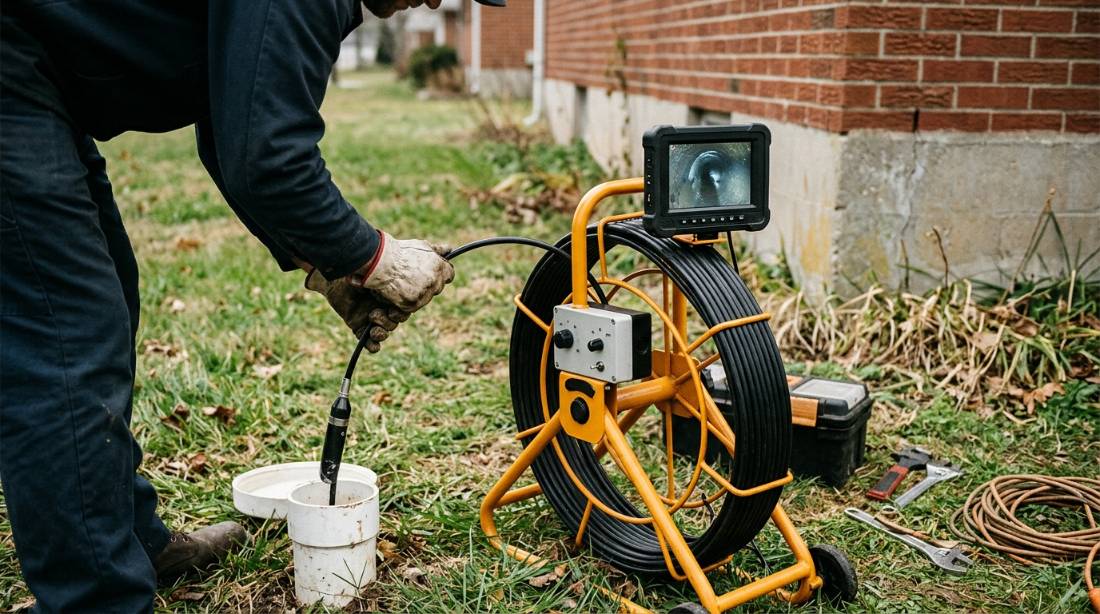
Camera the full run, locate every defect, then clean the pipe thoroughly, lining bonds to the host pipe and cannot be installed over roots, scale or grease. Measurements are taken off the camera, so the accuracy of this stage determines the fit of everything after.
Two pits, not a trench
An entry pit and a receiving pit are excavated, typically at the house and near the main connection. Everything between them stays untouched, that is the entire point of the method, and it is what keeps a drive, a walk or a lawn intact.
Install, cure, verify
A resin liner is inverted or pulled into place and cured to form a new jointless pipe inside the old one; or a bursting head is winched through, fracturing the old pipe outward and towing new HDPE behind it. Then the camera goes back in to confirm the result and the reinstated connections.
Ask about the connections
Where branch lines join the lateral, a liner covers the opening and it must be reinstated, usually by a cutter working from inside. Confirm that every connection on the run has been identified before work starts and verified on camera afterwards.
On timing: most residential laterals are a one- to two-day job, with cure time dictating the pace on a lining install. Permitting and utility locates are frequently the longer part of the calendar, particularly where the run crosses a public right of way.
Two methods
Lining and bursting do different jobs
Trenchless is not one technique. The two mainstream methods suit opposite conditions, and choosing between them is the substance of the assessment.
Cured-in-place lining (CIPP)
A resin-saturated felt or fibreglass liner is inverted or pulled through the existing pipe and cured in place, forming a continuous jointless pipe bonded to the inside of the old one. Because it seals every joint at once, it is the definitive answer to root intrusion in clay. It slightly reduces internal diameter, usually immaterial, occasionally not on an already undersized line.
Pipe bursting
A conical head is winched through the old pipe, fracturing it outward into the surrounding soil while towing a new HDPE pipe in behind. It genuinely replaces the line rather than relining it, works where the old pipe has collapsed, and can upsize the diameter. It needs a clear corridor and adequate soil, so a locate of neighboring utilities is mandatory.
Where conventional still wins
Multiple faults at differing depths, a belly requiring regrade, a shallow line under open lawn, or a run with heavy utility congestion. In those cases open-cut is faster, cheaper and more certain, and being told so is a sign of an honest assessment.
What you should get afterwards
Before and after camera footage, confirmation that every branch connection has been reinstated and verified, the permit sign-off, and a written warranty naming what is covered and for how long. All four are standard on properly run jobs.
Trenchless is a way of not digging up something valuable. It is not a way of avoiding a diagnosis, and the assessment is the same either way.
Two pits instead of a trench. Where the line and the ground allow it.
Talk to a Pro TodayKentucky specifics
Where trenchless fits the state
Old jointed pipe under established neighborhoods is close to an ideal use case, with two real caveats.
Clay laterals
A textbook lining candidate
Jointed vitrified clay is the standard lateral across pre-1970 Kentucky housing, and its characteristic failure is root intrusion at joints rather than structural collapse. Lining seals every joint in a single operation.
This is the situation trenchless was developed for, and it is extremely common here.
Narrow older lots
No room for a trench anyway
In the older districts of Louisville, Covington, Newport and downtown Lexington, houses sit close together with the lateral under a drive or a narrow side yard. There is often nowhere sensible to put spoil from a trench.
Two pits fit where a trench does not, which sometimes makes trenchless the only practical method rather than the preferred one.
Karst ground
The caveat that matters
Limestone country produces settlement, voids and bellied sections. A liner faithfully reproduces a belly, and bursting into unstable ground needs care.
Where the camera shows lost grade, the honest answer is excavation of that section, trenchless will not fix a fall problem.
Pipe material, depth, what is on the surface, and what the camera showed.
Related work
The assessment beforehand, and the alternatives.
Questions
Trenchless repair, answered straight
Rebuilding or replacing a buried pipe by working from a small pit at each end instead of excavating along its whole length. The two mainstream methods are cured-in-place lining, which forms a new pipe inside the old one, and pipe bursting, which fractures the old pipe outward and pulls a new one through in its place.
It depends on what the camera shows. Lining needs a host pipe with enough remaining structure and, critically, correct fall, a liner reproduces a belly rather than fixing it. Bursting needs a clear corridor without utilities crossing tight against the line. Neither is a substitute for excavation where grade has to be restored.
Not per foot. It is usually cheaper in total when the surface above the line is expensive to reinstate, a concrete drive, a sidewalk, mature landscaping, a street crossing or a finished basement floor. Over an open lawn with shallow pipe, conventional excavation is frequently the better value and any honest assessment will say so.
A properly installed CIPP liner or an HDPE burst replacement is generally rated for around fifty years. The material outlives what it replaced by a wide margin, being jointless and immune to root entry. Ask for the specific warranty in writing, including what it covers and who honours it.
Slightly, the liner has a wall thickness. On a normally sized residential lateral the loss is immaterial, and the smooth jointless bore often improves flow compared with rough scaled clay or cast iron. On an already undersized line it is worth discussing, and bursting can upsize instead.
The liner covers those openings and each one must be reinstated, normally with a cutter working from inside the new pipe. This is routine, but confirm before work starts that every connection has been identified, and ask to see them verified on the closing camera pass.
Most residential laterals are one to two days on site, with resin cure time setting the pace on a lining job. The longer part of the schedule is usually before anyone arrives, permits and utility locates, particularly where the run crosses a public right of way.
Yes. Sewer lateral work is permitted and inspected across Kentucky jurisdictions, and where the run crosses a right of way there may be an additional street or encroachment permit. The contractor should handle all of it as part of the job.
Keep the drive, replace the pipe
Where the line and the ground allow it, two pits do the work of a trench. The camera says whether yours qualifies.