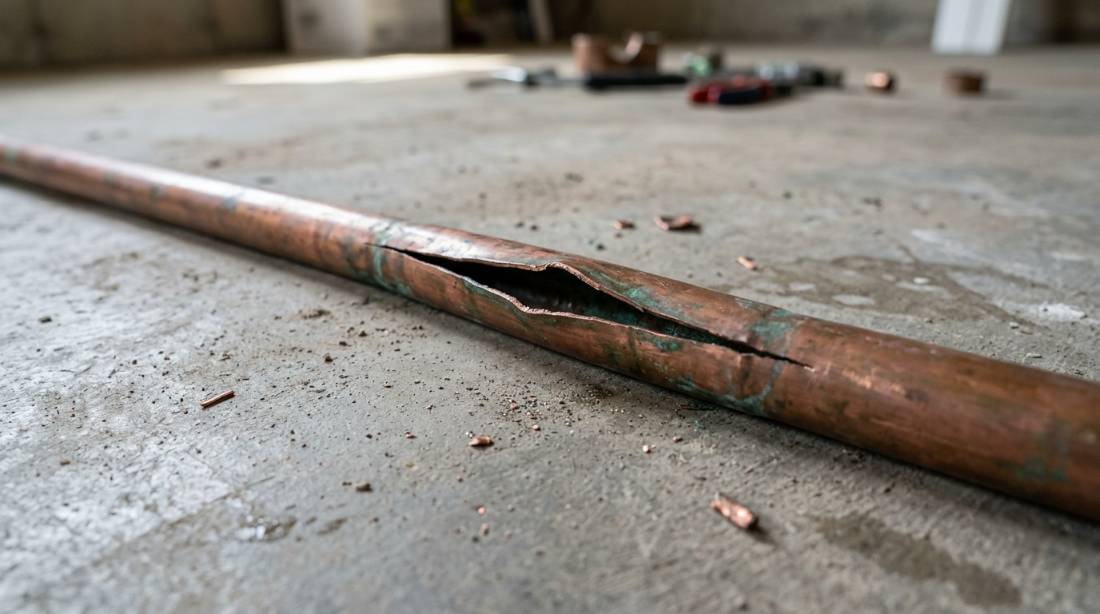
Main water line repair
The line you pay for and never see
From the meter to the house, the water service line is the homeowner’s in nearly every Kentucky jurisdiction. It is buried, it is under pressure every second of the day, and when it starts leaking the evidence is usually a water bill rather than a puddle, because limestone ground drains the proof away.
Statewide. Pressure loss and a rising bill together are worth a same-week call.
Symptoms
How a buried supply leak shows up
A service line leak is a continuous leak. It never stops, it never gets better, and the bill is usually the first honest witness.
The bill stepped up
Same household, same habits, a noticeably larger bill. Water leaving a pressurised line runs twenty-four hours a day, and the meter records every gallon of it.
Meter moves with everything off
Shut every fixture and watch the meter or its leak indicator for fifteen minutes. Movement means water is escaping. Close the shutoff at the house and repeat: still moving puts the leak outside, between meter and building.
Pressure has dropped
Weak flow at fixtures, particularly upstairs or when two things run at once. A leak, a partially collapsed line, or decades of internal corrosion narrowing the bore will all do it.
A wet or oddly green strip outside
Where the ground cooperates, a line of unusually lush grass or soft ground traces the run. In much of Kentucky the karst ground drains it away and you get nothing at all.
Meter moving with the house shut off? That is water leaving before it reaches you.
Get It LocatedBefore you call
Prove it is outside in fifteen minutes
Shut everything down
Every tap off, no washing machine or dishwasher, ice maker off, irrigation off. Tell the household not to flush anything for a quarter of an hour, a single flush invalidates the whole test.
Read the meter, wait, read again
Note the numbers or watch the small leak-indicator dial many meters carry. Fifteen minutes of no water use should mean no movement whatsoever. Any change means water is escaping somewhere on the system.
Close the main shutoff and repeat
Find the valve where the line enters the house and close it. If the meter still moves, the leak is between the meter and the building, the service line. If it stops, the leak is inside. That one result changes the entire scope and cost of the job.
Bring this to the call
Meter moving or still, inside or outside, when the bill changed, whether pressure has dropped, and the age of the house. Those five facts usually identify the likely pipe material and the likely failure before anyone arrives.
One thing worth knowing about the meter: in most Kentucky systems the utility owns the line up to and including the meter, and you own everything after it. If the leak is on the utility side, it is their repair, and the location work is what proves which side it is on.
The work
Locate first, then repair or replace
The expensive part of this job is excavation, and excavation is priced by how much of it you do. Everything worth paying for happens before the shovel.
Acoustic location
Water escaping a pressurised line makes a characteristic noise that carries along the pipe and through the ground. Ground microphones and contact probes walked along the run find the peak. On a long rural service line this is the difference between a spot dig and trenching a paddock.
Isolation and pressure testing
Dividing the run and pressurising sections proves which length is losing water. Unglamorous, decisive, and the step that stops an excavation being exploratory. It also confirms whether the leak is on your side of the meter at all.
Spot repair
A single failure in an otherwise sound line, a nicked pipe, a failed compression fitting, a rock working through a poly line, is a small excavation, a cut-out and a new section. Right answer when the pipe’s general condition is good and its material is not obsolete.
Replacement, often trenchless
Galvanized steel, old polybutylene, or a line that has already been patched more than once is telling you something. Directional boring or pipe pulling replaces the run from a pit at each end, which matters when the line goes under a drive, a walk or mature landscaping.
Almost nobody regrets spending an hour locating a leak. Plenty of people regret the second trench.
Located, then priced. Ask where the leak is before agreeing what it costs.
Talk to a Pro TodayKentucky specifics
Why service lines fail here
Ground chemistry, pipe vintage and long rural runs give this line a harder life than most.
Karst ground
The leak with no puddle
Across the Bluegrass, central Kentucky and the cave country, water escaping a buried line drains downward through fissured limestone rather than surfacing. A leak that would leave an obvious wet patch elsewhere leaves nothing here.
No wet spot is not evidence of no leak. The meter is the witness, not the lawn.
Old pipe materials
Galvanized, poly and polybutylene
Pre-1960 houses often still have galvanized steel service lines, rust-choked from the inside. The 1970s and 80s added polybutylene, which fails at fittings and is effectively at end of life everywhere it survives.
Finding either material usually moves the conversation from repair to replacement, because the next failure is not far behind.
Long rural runs
Meter or well to house
On farm properties and across the eastern counties the run from meter or wellhead to the building can be hundreds of feet, shallow, and of unknown vintage.
Locating precisely is worth far more on a long run than on a short suburban one, it is the difference between one hole and a trench.
Freeze depth
Shallow lines split
A service line laid too shallow, or one exposed where it enters a crawl space, is at genuine risk in a hard Kentucky January. Failures cluster in the days after a deep freeze.
If the line failed in winter, ask about its depth at the point of repair rather than just repairing it.
Bill, pressure, meter test result, and the age of the house.
Related work
Finding it, and what happens when the whole run is done.
Questions
Main water lines, answered straight
In most Kentucky systems the utility owns the line up to and including the meter, and the property owner owns everything from the meter to the house. That means the buried run across your yard is yours to repair. Confirm with your water district, because the demarcation point does vary.
Shut off every fixture and watch the meter for fifteen minutes, any movement means water is escaping. Then close the main shutoff where the line enters the house and watch again. Still moving puts the leak between the meter and the building; stopped puts it inside. That single test defines the job.
Because of what Kentucky is made of. In karst limestone country, water escaping a buried line drains straight down through fissured rock instead of surfacing. A leak that would be obvious in clay soil leaves no visible sign at all here, which is why the meter matters more than your eyes.
It depends on material and history. A single failure in sound modern pipe is a spot repair. Galvanized steel, polybutylene, or a line that has already been patched more than once is generally telling you the next failure is coming, and replacing the run is the better value even though it costs more today.
Usually not. Accurate acoustic location means a spot repair is a small excavation at a marked point. Where the full run needs replacing, directional boring or pipe pulling can install a new line from a pit at each end, which is what saves a driveway, a sidewalk or mature landscaping.
It is not a midnight emergency in the way a burst pipe inside the house is, but it does not improve. You pay for every gallon continuously, saturated ground can undermine a foundation or a slab, and a weakened line tends to fail properly at the least convenient moment, often during a freeze.
If low pressure was caused by the leak or by a corroded, narrowed line, yes, often dramatically. If the cause is elsewhere, such as a failed pressure regulator or corroded interior piping, replacing the service line will not fix it. Diagnosing which is the case is part of the visit.
For a replacement, generally yes, and there may be a right-of-way permit if the work crosses a sidewalk or street. Requirements vary between Kentucky water districts and cities. The contractor should be pulling it as part of the job, and doing so is a reasonable thing to ask about up front.
Every gallon that never reaches the house is still on your bill
Fifteen minutes with the meter tells you whether the leak is outside. Then it is a matter of finding exactly where.