Whole-home repiping
At some point you stop repairing and start replacing
Repiping is not a repair anybody wants. It is what happens when the supply pipework in a house has aged past the point where fixing the next leak is a sensible use of money, because the pipe that leaked and the pipe that has not yet leaked are the same age, in the same water, doing the same job.
Statewide. Most houses stay livable throughout, water off in stages, not for a week.
The threshold
Four signals that patching has stopped paying
Nobody repipes a house on a whim. These are the situations where the arithmetic has usually already tipped.
Repeated pinhole leaks
A second or third pinhole in copper within a couple of years is not coincidence. It points at water chemistry, velocity or a manufacturing era, and it will keep happening at the weakest remaining point.
Rust-choked galvanized
Brown water on first draw, pressure that collapses when a second tap opens, and threads that crumble when disturbed. Galvanized supply narrows from the inside until it is functionally solid.
Polybutylene anywhere
Grey or blue plastic supply pipe from roughly 1978 to 1995. It fails at fittings and from the inside out, gives little warning, and is effectively at end of life wherever it survives.
You are renovating anyway
Walls open for a kitchen or bathroom is the cheapest repiping opportunity a house ever gets. The labour of access is already paid for by another trade.
Second leak in two years? Worth pricing the whole house before the third.
Get an AssessmentThe job
What a week of repiping looks like
Walkthrough and plan the route
Every fixture, every run, every access point. A good plan minimises the number of holes by using existing chases, attics, crawl spaces and closets, and it establishes where the manifold or the main trunk goes. This is where the disruption is decided.
Run new pipe alongside the old
New lines are installed while the existing system stays in service, so the house keeps water for most of the job. Access holes are cut deliberately, in the least visible places that reach the run.
Cut over, test, then close up
Fixtures are transferred to the new system, the whole thing is pressure tested and inspected, and the old pipe is abandoned in place or removed where it is accessible. Drywall patching and finishing follow, confirm before you sign whether that is in your quote or someone else’s.
The question that decides your quote comparison
Who repairs and finishes the drywall, and to what standard, patched, textured, primed, or painted to match. This single line item explains most of the gap between two apparently similar bids.
Water outage is usually far shorter than people fear. Because the new system is built alongside the old one, most houses lose water only during the cutover, typically part of a day, rather than for the duration of the work.
Materials
PEX or copper
Both are legitimate. The choice usually comes down to budget, layout and how long you intend to own the house, and to a couple of Kentucky-specific factors that are worth naming.
PEX
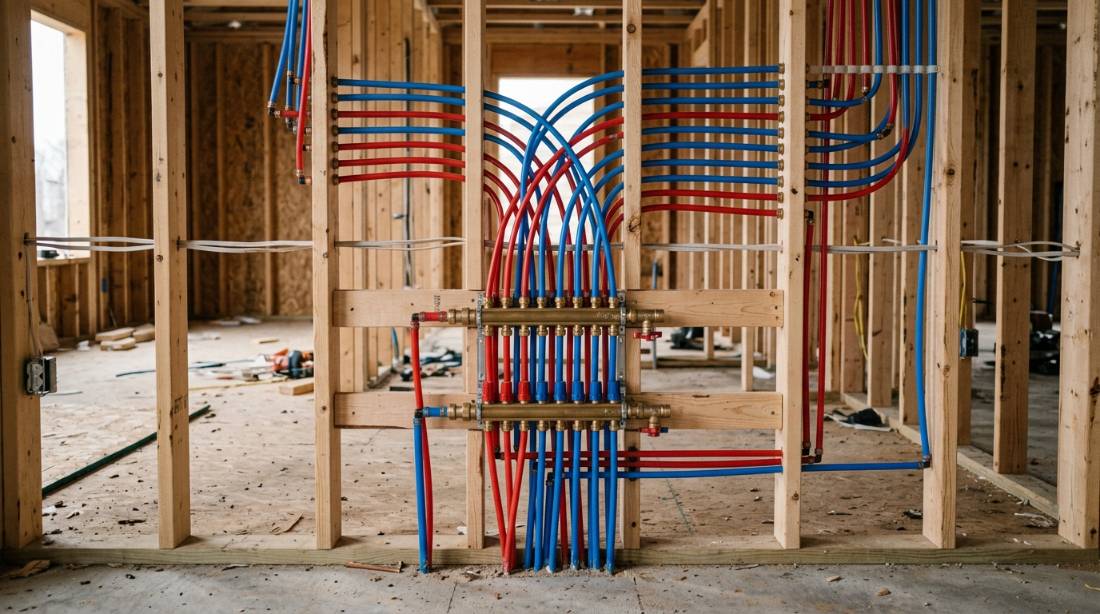
Flexible tubing run in long continuous lengths, often from a central manifold with a dedicated line to each fixture. Far fewer joints, far less destructive to install because it snakes through cavities, immune to the pinhole corrosion that afflicts copper, and cheaper. It must be protected from UV and from rodents in accessible spaces.
Copper
Rigid, proven over a century, and preferred by some owners for resale perception and durability. More expensive in both material and labour, and vulnerable to pinhole corrosion where water chemistry or high velocity works against it, which is precisely the failure that prompts many repipes in the first place.
Home-run manifolds versus trunk and branch
A manifold with an individual line to each fixture gives balanced pressure, isolation valves per fixture, and faster hot water at distant taps. Trunk-and-branch uses less pipe and suits some layouts better. Worth asking which is being proposed and why.
What gets fixed along the way
Repiping is the moment to correct undersized runs, add shutoffs at fixtures that never had them, relocate a water heater connection, or add a line for a future bathroom. Doing any of it later means opening walls again.
The pipe that just failed and the pipe that has not failed yet went in on the same day, in the same water. That is the whole argument.
Priced per house, not per leak. Ask what the plan does about access.
Talk to a Pro TodayKentucky specifics
Why houses here reach this point
Hard water, old housing stock and a couple of unlucky material eras.
Hard water
Scale inside every run
Limestone groundwater deposits mineral inside supply pipe continuously. In galvanized steel it combines with rust to narrow the bore; in any material it shortens the life of heaters, valves and fixtures.
A repipe without addressing water hardness solves the immediate problem and leaves the cause in place.
Pre-1960 housing
Galvanized as standard
Large parts of Louisville, Lexington, Covington, Newport and the older county seats are full of houses originally piped in galvanized steel. Much of it is now sixty to ninety years old.
Brown first-draw water and pressure that collapses on a second tap are the two everyday symptoms.
The polybutylene era
1978 to 1995 construction
Kentucky got its share of polybutylene supply during that window, particularly in suburban and manufactured housing. It fails without much warning, and insurers and buyers both know it.
If you find grey or blue plastic supply pipe with crimped fittings, get it identified before you spend money elsewhere.
Crawl spaces
Where the runs actually live
A great many Kentucky houses distribute supply through a vented crawl space, which makes access for a repipe far easier than in a slab house, and makes freeze protection part of the specification.
Repiping a crawl-space house is usually less destructive and less expensive than repiping a slab one.
Age, pipe material if known, slab or crawl space, and what has failed so far.
Related work
The lines either side of the house, and what makes them last.
Questions
Repiping, answered straight
Repetition is the signal. A second or third leak within a couple of years, brown water on first draw, pressure that collapses when a second tap opens, or the presence of polybutylene or heavily corroded galvanized all mean the system rather than the section has reached the end. One leak in otherwise sound pipe is just a repair.
Both are legitimate. PEX is cheaper, far less destructive to install, has fewer joints and does not suffer the pinhole corrosion that ends many copper systems. Copper is rigid, long proven and preferred by some owners for resale. In hard Kentucky water, PEX has a real practical advantage.
Fewer than you would expect. A good plan routes through attics, crawl spaces, closets and existing chases, cutting deliberate access holes rather than opening walls wholesale, and PEX in particular can be snaked through cavities. The count of access points is one of the best measures of a well-planned job.
Almost always. The new system is built alongside the existing one, so water stays on for most of the job and goes off only for the cutover, typically part of a day. Most households stay put, with some noise and dust for the duration.
A typical single-family house is a few days to about a week for the plumbing, plus drywall repair and finishing afterwards. Size, number of bathrooms, slab versus crawl space, and how much finished surface has to be opened are what drive it.
This is the question to settle before comparing quotes. Some contractors patch to a rough finish, some finish and texture, some leave it entirely to you. It is the single biggest reason two repiping bids differ, so get the scope and the standard written down.
It depends on what is in the walls. Known-bad material like polybutylene, or visibly failing galvanized, will surface in an inspection and be negotiated against you, often for more than the work would have cost. Sound copper with one historic repair generally does not justify it.
Worth considering. Kentucky groundwater is hard nearly everywhere, and scale shortens the life of heaters, valves and fixtures regardless of what the pipe is made of. Repiping is the natural moment to add treatment, since the plumber is already in the system.
The next leak will be in pipe the same age as the last one
If you have had two, price the house rather than the section. It is usually the cheaper number.