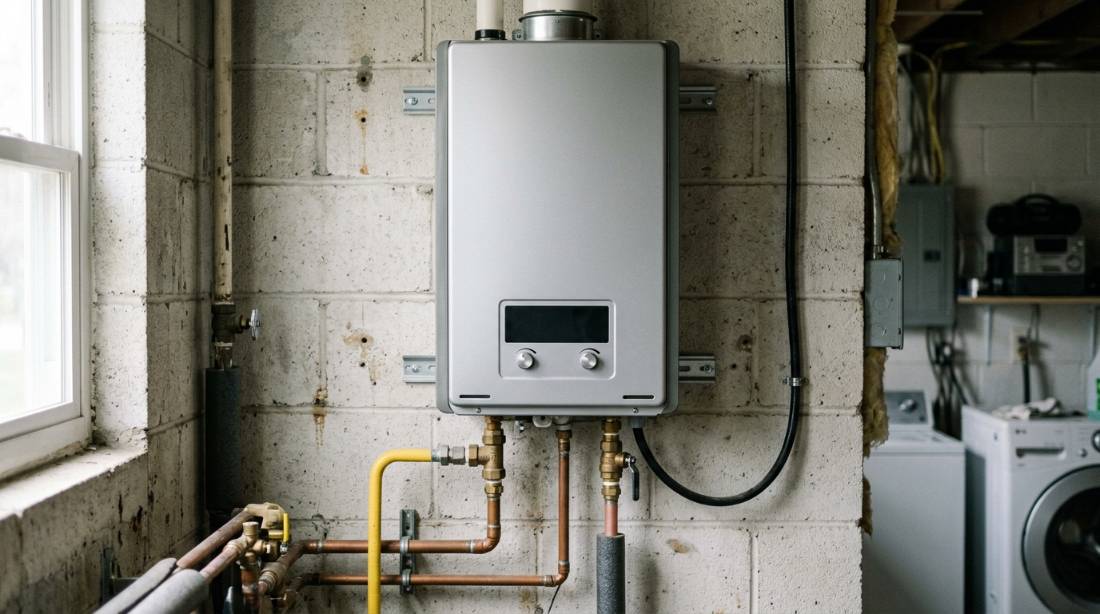
Tankless water heaters
Excellent in the right house, oversold in the wrong one
Tankless gives endless hot water and no standby loss. It also needs a gas line that can feed it, dedicated venting, and, in Kentucky water, a descaling routine somebody actually follows. We quote both options and tell you which one your house wants.
Statewide. We will quote a conventional tank alongside it so you can compare honestly.
Feasibility
What decides whether tankless works here
Four questions answered before anyone talks about brands or flow rates.
Gas supply capacity
A whole-home tankless unit can demand 150,000 to 199,000 BTU, often more than the existing half-inch branch can deliver alongside a furnace and range. Upsizing the run, or the meter, is frequently the largest line on the quote.
Venting route
Sealed-combustion units need dedicated stainless or PVC venting to an approved termination, not the old atmospheric flue. A short sidewall run is easy; a unit in the middle of a basement with no exterior wall nearby is not.
Water hardness
Kentucky water scales the heat exchanger, which is the expensive part. An isolation valve kit and annual descaling are not optional extras here, they are the maintenance plan the warranty assumes.
Groundwater temperature
Incoming water sits near 50°F in a Kentucky winter, so the unit works harder for the same output. Sizing on a summer flow chart is how households end up with lukewarm showers in January.
Thinking about switching? Get both a tankless and a tank quote before you decide.
Compare Both OptionsOn the day
What an installation involves
Remove the tank, prepare the wall
The old unit is drained and taken out, and the mounting location is confirmed for clearances, venting route and service access. The unit needs to be reachable for descaling later, behind a shelf unit is a decision you regret annually.
Gas, water and venting
A correctly sized gas run with its own shutoff and sediment trap, water connections through isolation valves so descaling takes minutes rather than hours, and the vent assembled and terminated to the manufacturer specification and local code.
Commission, test, and set expectations
Fire the unit, verify gas pressure under full load, check the vent draft, measure temperature rise at realistic flow, and walk you through the descaling procedure and what a delay at the tap actually means.
The isolation valve kit is the part people skip
Without service valves, annual descaling means breaking pipework instead of connecting a pump for twenty minutes. It costs little at installation and it is the difference between maintenance that happens and maintenance that does not.
Expect a short delay at the tap while the unit fires and the cold slug in the pipe clears. That is normal for tankless, not a fault, and it is the one thing households find surprising after a switch.
Straight talk
Where tankless wins and where it does not
We install plenty of these and we also talk plenty of people out of them. Both are the same service.
It wins on long draws and small footprints
Filling a large tub, back-to-back showers for a full house, or a mechanical room where the tank is eating floor space you need. Endless hot water is genuinely different, not marketing.
It wins on standby loss over decades
No tank sitting at temperature all year. In a low-use household, or a rental with variable occupancy, that saving is real, though it takes years to offset the higher install cost.
It struggles with simultaneous demand
Two showers and a dishwasher at once needs a properly sized unit, and in winter that sizing gets larger. Undersized tankless is the most common regret we are called out to look at.
It punishes neglected maintenance
A tank with scale loses efficiency. A tankless heat exchanger with scale fails. If nobody is going to descale it annually, a good tank is the better engineering decision for that household.
The households happiest with tankless are the ones who were told the truth about the gas line, the venting and the descaling before they signed.
Want a straight answer for your house?
Talk to a Pro TodayKentucky specifics
What the local conditions demand
Hard water, cold incoming supply and a lot of houses with gas lines sized decades ago.
Hard water
Descaling is the whole ballgame
Scale forms on the heat exchanger surfaces where the water is hottest, and in most of the state the mineral load is high enough to matter within a year.
Service valves at installation, a descale every twelve months, and softening ahead of the unit where it is justified.
Winter inlet
Fifty-degree water changes the math
Temperature rise is what the unit is rated on. A unit that delivers five gallons a minute in August delivers noticeably less in January, on the same setting.
We size on winter inlet temperature, which is why our recommendation is sometimes a size up from the one you were quoted elsewhere.
Existing gas runs
Half-inch branches are common
Older Kentucky houses were piped for a furnace, a range and a tank heater. A tankless unit added to that run starves at full fire, and the unit throws an error rather than a warning.
A load calculation on the whole gas system comes before the unit selection, not after.
Well supply
Sediment reaches the exchanger
On a private well, sand and iron travel with the water and the narrow passages of a tankless exchanger are less forgiving than an open tank.
Sediment filtration ahead of the unit is a requirement in our specification, not an upsell.
Tell us the fuel, the bathroom count and where the unit would live.
Related work
The alternative, the protection, and the supply work that sometimes comes with it.
Questions
Tankless, answered straight
It will not run out, but it is limited by flow rate. A correctly sized unit supports the fixtures you actually run at once; exceed that and the temperature drops rather than the hot water stopping. Sizing is what makes the promise true.
Often, yes. Whole-home units commonly need 150,000 to 199,000 BTU, which is more than many existing half-inch branch runs can supply alongside a furnace and range. We calculate the whole gas system load before recommending a unit, because that upgrade is a real cost and you should see it up front.
A great deal. Scale accumulates on the heat exchanger and eventually damages the most expensive component in the unit. Annual descaling, made easy by service valves fitted at installation, is the maintenance the warranty effectively assumes.
The unit has to sense flow, fire, and then push the cooled water already sitting in the pipe out of the way. It is a few extra seconds compared with a tank and it is inherent to the technology, not a defect. A recirculation option can reduce it where the run is long.
A garage often works if the unit is protected from freezing and the vent route is sound. A crawl space is usually a poor choice, service access is bad, freeze exposure is real, and descaling something you have to crawl to reach tends not to happen.
Whole-home electric tankless needs an electrical service upgrade in most houses, the amperage is substantial. It works well for a single fixture or an outbuilding, and it is rarely the right answer for a whole Kentucky home on winter inlet temperatures.
Fifteen to twenty years is realistic with annual descaling, and considerably less without it. Heat exchangers can often be replaced rather than the whole unit, which is a genuine advantage over a tank once the labour is accounted for.
In most Kentucky jurisdictions, yes, the work involves gas piping and venting, which is exactly what inspection exists to check. Any quote that treats the permit as optional is treating the inspection as optional.
Endless hot water, if the house is right for it
Tell us what you have and we will quote tankless and tank side by side, with the gas and venting work shown honestly.