Cast iron drain replacement
The stack behind the wall is older than everything else in the house
Cast iron drainage was built to last, and much of it has, for eighty or ninety years, in Kentucky houses that have been renovated around it three times. But it scales, it corrodes from the inside, and eventually the bottom of the pipe channels out entirely. By the time it announces itself, it has usually been failing for a decade.
Statewide. Camera first, the inside of the pipe is the only thing that settles it.
Symptoms
How old cast iron tells you
Drainage problems that resist every ordinary explanation usually come back to the pipe itself.
Drains that keep slowing
Cleared, fine for a while, slow again. A stack scaled to half its bore blocks on ordinary use, and clearing removes the blockage without touching the cause.
Sewage smell with no visible leak
A pinholed or channelled cast-iron section leaks gas before it leaks much water. A persistent smell in a bathroom, a basement or a wall cavity with nothing to see is a strong signal.
Stains or damp on a wall or ceiling
Waste water tracking down the outside of a corroded stack shows up as a stain on the wall below or on a basement ceiling. It is usually well advanced by the time it is visible.
Rust flakes and pitting on exposed pipe
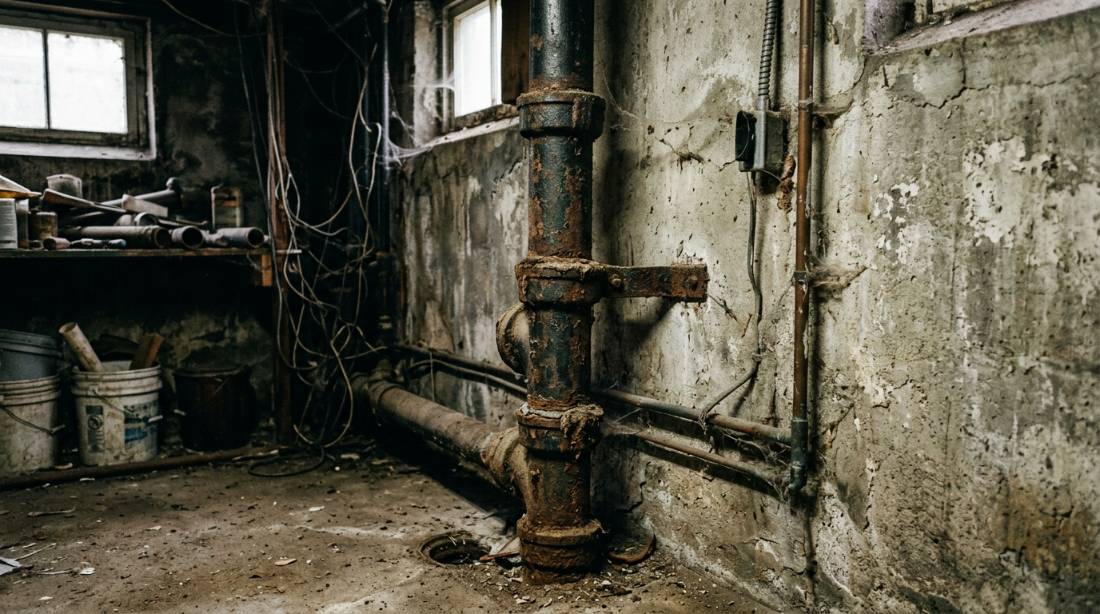
Where the stack is visible in a basement, flaking rust scale, deep pitting or a soft spot that a screwdriver can penetrate says the wall thickness is gone.
Old house, drains slowing everywhere? A camera in the stack settles it in an hour.
Book a Camera InspectionAssessment
Establish condition before scope
Camera the stack and the horizontal runs
The interior is what matters and it is the only thing that answers the question. The camera shows remaining bore, scale depth, cracking, and whether the bottom of a horizontal run has channelled out, the characteristic cast-iron failure.
Sound the exposed sections
Where pipe is accessible in a basement or crawl space, tapping and probing finds soft, thin areas that the camera cannot judge from inside. Heavy flaking and pitting on the outside usually mean the wall is thinner than it looks.
Map what is reachable
Basement horizontals and crawl-space runs are straightforward. A stack inside a finished wall is a different job, and the access plan, which walls open, which ceilings, whether the route can shift to an adjacent chase, is what determines the real cost.
Ask for scope in three parts
What is being replaced, how it is being accessed, and who restores the finishes. Cast-iron replacement inside finished walls is a demolition and rebuild job as much as a plumbing one, and the plumbing is often the smaller half.
One useful sequencing point: if any bathroom or kitchen renovation is even loosely planned, doing the drain work at the same time is dramatically cheaper. The walls are open, the finishes are already being replaced, and the access that dominates the cost is already paid for.
The work
Replace, or line
Cast iron has two honest futures: cut it out and replace it with PVC, or line it where the geometry and remaining structure allow. Which one applies depends almost entirely on what the camera found.
Section replacement in PVC
Cut out the failed length, connect new PVC to sound cast iron with shielded couplings, and support it properly. The standard answer for accessible basement horizontals and for the base of a stack, which is where channelling usually begins.
Full stack replacement
Where the vertical stack is comprehensively scaled or corroded, replacing it top to bottom avoids doing it again in five years. This is the invasive version, it involves opening the wall the stack runs in, on every floor it passes.
Lining
A cured-in-place liner can rebuild a horizontal cast-iron run from the inside where the host pipe retains enough structure, which avoids opening a basement slab or a finished ceiling. It is not suitable for pipe that has channelled through or lost its shape, and vertical stacks with multiple connections are harder cases.
Supports, slope and connections
New PVC needs proper support at correct intervals and the right fall, old cast iron was heavy enough to be forgiving about both. Connections to remaining cast iron want shielded couplings rather than the unshielded rubber the previous owner probably used.
Cast iron does not fail at the top. It channels out along the bottom of the horizontal run, where water sits, which is exactly where nobody is looking.
Assess the whole system, replace what has failed.
Talk to a Pro TodayKentucky specifics
Where the cast iron is
Every pre-1970 Kentucky city neighborhood is full of it, and the water it carries has not been kind.
Pre-1970 housing
Standard everywhere
Old Louisville, the Highlands, Crescent Hill, Covington, Newport, downtown Lexington and every older county seat were built with cast-iron waste stacks and drains as a matter of course.
Much of it is now approaching or past a century, which is at the far end of any reasonable expectation.
Hard water
Scale on a rough surface
Limestone water deposits mineral inside drain lines, and once the interior of cast iron has roughened with corrosion the scale accumulates faster. Bore loss compounds year after year.
A camera in an old stack frequently shows half the diameter gone, which is why ordinary use now causes blockages.
Basement horizontals
Where it fails first
The horizontal run under a basement floor or across a basement ceiling sits with water in the bottom of the pipe far more of the time than a vertical stack does.
That is where channelling starts, and it is the section most often replaced on its own.
Renovated around, never replaced
Three kitchens, one drain
A great many Kentucky houses have been renovated repeatedly with the original waste system left in place behind the new finishes.
Which is why the next renovation is the right moment to deal with it, the access is already being paid for.
House age, where drains are slow, and whether you can see the stack anywhere.
Related work
Diagnosis, clearing, and the supply pipe of the same era.
Questions
Cast iron drains, answered straight
Commonly cited at seventy-five to a hundred years in favourable conditions, and considerably less where water is hard or the pipe sits with standing water in it. A great deal of Kentucky cast iron is now at or past the end of that range, which is why it is failing across whole neighborhoods at once.
A camera inspection, because the inside is the only thing that answers it. It shows remaining bore, scale depth, cracks, and whether the bottom of a horizontal run has channelled out. Externally, heavy flaking, deep pitting or a spot a screwdriver can penetrate all indicate the wall thickness is gone.
The characteristic cast-iron failure: the bottom of a horizontal pipe corrodes away while the top remains, leaving an open trough rather than a pipe. Waste then leaks into the surrounding soil or structure. It is invisible from outside and obvious on camera, and it cannot be repaired by cleaning.
Sometimes. A cured-in-place liner can rebuild a horizontal run from the inside where the host pipe retains enough structure, which avoids breaking a basement slab or opening a finished ceiling. Pipe that has channelled through or lost its shape cannot be lined durably, and stacks with many connections are harder.
For a vertical stack inside a finished wall, generally yes, on each floor it passes. Basement horizontals and crawl-space runs are usually accessible without demolition. The access plan is what dominates the cost, so it is worth asking whether the route can shift to a more convenient chase.
If a renovation is anywhere in your plans, yes, and it is the single best piece of timing advice on this page. The walls are open, the finishes are already being replaced, and the access work that makes drain replacement expensive is already paid for by another trade.
PVC in almost all residential work, lighter, smooth-bored, corrosion-proof and far cheaper to install. It needs proper support at correct intervals and correct fall, because it is not heavy enough to be as forgiving as cast iron was. Connections to remaining cast iron should use shielded couplings.
It is one of the likeliest causes in an older house. A pinholed or channelled section leaks gas long before it leaks enough water to be visible, so a persistent smell in a bathroom, basement or wall cavity with nothing to see is worth investigating rather than masking.
Ninety years is a good run for any pipe
If the drains in an old house keep slowing, look inside the stack before clearing it again.