Outdoor spigots
The first thing a hard freeze takes out
A hose left connected through one cold night is enough. The split usually happens inside the wall, and you find out in April when the spigot is turned on and water appears in the basement instead of the garden.
Statewide. Disconnect every hose before the first hard freeze, it is the whole prevention plan.
Diagnosis
What an outdoor spigot is telling you
Four common conditions, and only one of them is minor.
Drips from the spout
A worn washer or seat, and the cheapest repair on the house. Worth doing promptly, because a spigot dripping into a hose left connected in autumn is how the freeze damage starts.
Water inside when it is turned on
A split pipe or a cracked valve body behind the wall, almost always freeze damage from a previous winter. Turn it off, leave it off, and get the wall opened before it runs again.
Weeps at the handle
Packing nut or stem seal. Tightening the packing nut sometimes buys time, but on an old bib the honest answer is usually replacement with a frost-free unit.
No flow or a trickle
A closed or corroded interior shutoff, a blocked line, or on older galvanized supply a nipple that has narrowed to nothing behind the siding.
Water appearing indoors when you use the spigot? Leave it off and call.
Get It Looked AtHow we work
Replacing it so it survives the next winter
Establish what is behind the wall
Where the branch runs, what it is made of, and whether there is an accessible interior shutoff. On a crawl-space or basement wall this is usually visible; on a slab or a finished wall it needs a little more care.
Fit a frost-free bib at the right length
A frost-free hose bib closes its seat well inside the heated envelope, so the exposed barrel drains empty. The length has to suit the wall thickness, too short and the seat sits in the cold, which defeats the entire point.
Add a vacuum breaker, pitch it, and test
A backflow preventer so garden chemicals and standing hose water cannot siphon into the supply, a slight downward pitch so the barrel drains, and a test with the hose off and on to confirm both flow and shutoff.
A frost-free bib only works with the hose disconnected
The barrel has to drain. Leave a hose attached and the water cannot escape, so it freezes and splits the pipe exactly as an ordinary spigot would. The one habit protects the hardware.
Where an interior shutoff exists, the belt-and-braces approach is to close it in November, open the outdoor bib to drain, and leave it open all winter. That combination has never given us a callback.
Prevention
Why the damage happens inside the wall
The mechanism is worth understanding, because it explains why the leak is not where the ice was.
Water expands, and the pipe holds it
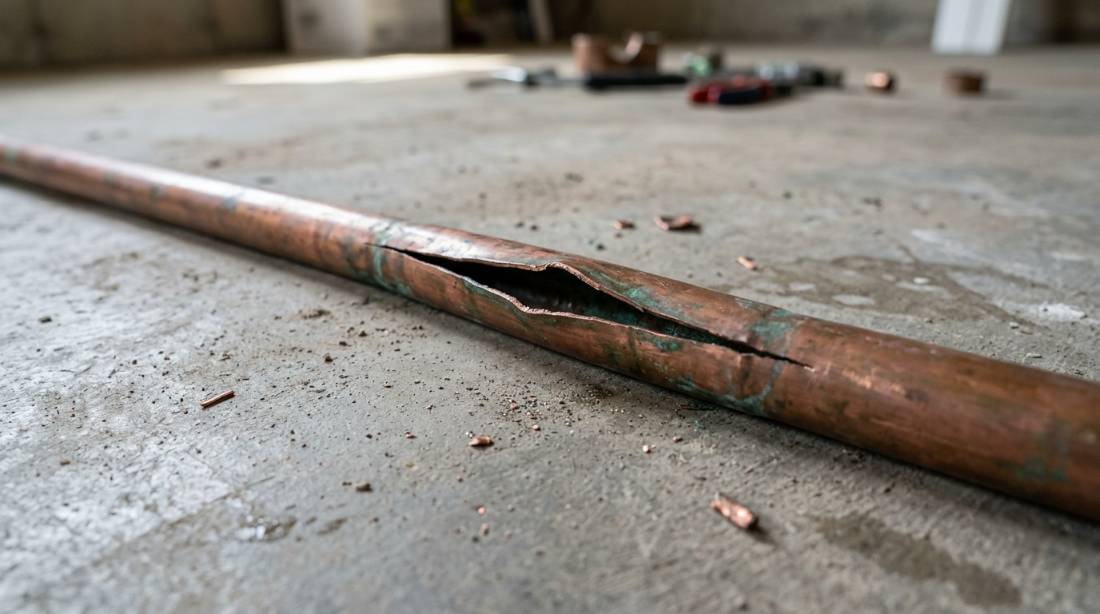
Freezing water expands about nine per cent, and in a closed section of pipe that pressure has nowhere to go. The pipe or the valve body splits, often a foot or more back from the spigot itself, inside the wall.
The leak appears months later
While it is frozen, nothing leaks. The split only reveals itself when the ice thaws or the spigot is next opened, which is why the discovery so often comes with spring gardening rather than the cold snap.
Hoses are the single biggest cause
A connected hose keeps the barrel full and adds a reservoir of water at the coldest point. Disconnecting hoses in autumn prevents the majority of the freeze damage we attend.
Insulated covers help, but are not the fix
A foam cover slows heat loss on an ordinary bib and is worth using. It does not empty a barrel that a hose has kept full, and it does not turn a standard spigot into a frost-free one.
Every spring we open walls on split pipes that a five-second job in November would have prevented: take the hose off.
Before the first freeze: hoses off, bibs drained, interior valves closed.
Talk to a Pro TodayKentucky specifics
What the local conditions demand
Freeze-thaw cycling rather than sustained cold, and a lot of old hardware on old supply pipe.
Freeze-thaw cycling
Repeated stress, not one hard night
Kentucky winters swing above and below freezing repeatedly. Each cycle stresses a marginal joint or an already-cracked valve body a little further.
A frost-free bib and a disconnected hose remove the mechanism entirely, which matters more here than in a steadily cold climate.
Crawl space walls
The branch runs through cold space
Many Kentucky hose bibs are fed by a branch running through an unheated crawl space, so the pipe behind the wall is barely warmer than the outside air.
Insulating that branch, and sometimes rerouting it, is part of the job rather than an extra.
Galvanized supply
The nipple is the weak point
On older houses the short galvanized stub feeding the spigot is corroded and narrowed, and it frequently fails at the thread when the bib is changed.
We expect to replace back to sound pipe, and we say so before starting rather than mid-job.
Well systems and outbuildings
Barn and garden lines freeze first
Lines to barns, garden taps and outbuildings are often shallow, uninsulated and rarely used, which is a reliable combination for freeze failure.
Frost-free yard hydrants and a proper drain-down arrangement suit these better than a standard bib.
Tell us where the spigot is and whether water has appeared indoors.
Related work
Freeze work, and what a split behind the wall becomes.
Questions
Hose bibs, answered straight
A spigot with a long barrel whose valve seat sits well inside the heated part of the house. When you close it, the exposed barrel drains empty, so there is no water at the cold end to freeze. It is the correct hardware for a Kentucky winter.
Yes, and it is essential. A connected hose keeps the barrel full, which means a frost-free bib freezes and splits exactly like an ordinary one. The hardware only works if the barrel can drain.
The pipe or valve body behind the wall has split, almost certainly from a previous freeze. Leave the spigot closed, close the interior shutoff if there is one, and have it opened up, running it again just puts more water into the wall.
Often, yes, a washer and seat kit is cheap. But if the bib is an old non-frost-free unit on an exterior wall in Kentucky, replacing it with a frost-free one during the same visit removes the freeze risk for good, and the labour is largely the same.
It stops water being siphoned back from a hose into your drinking supply if pressure drops, relevant whenever a hose sits in a bucket, a pool, or a sprayer with garden chemicals. Code requires backflow protection on hose connections and it costs very little.
Before the first hard freeze, in most of Kentucky that means doing it in November rather than waiting for the forecast. Disconnect hoses, drain the bibs, close interior shutoffs where they exist, and leave the outdoor spigot open so any remaining water can escape.
They help on a standard bib and cost almost nothing, so yes. They are not a substitute for disconnecting the hose or for a frost-free replacement, they slow heat loss, they do not empty a full barrel.
A straightforward swap on an accessible wall is usually under an hour. It runs longer where the supply is galvanized and corroded, where the wall has to be opened, or where the branch runs through a crawl space that needs insulating while we are there.
Replace it before the next cold snap
A frost-free bib and a disconnected hose is the whole solution, and it is a short visit.