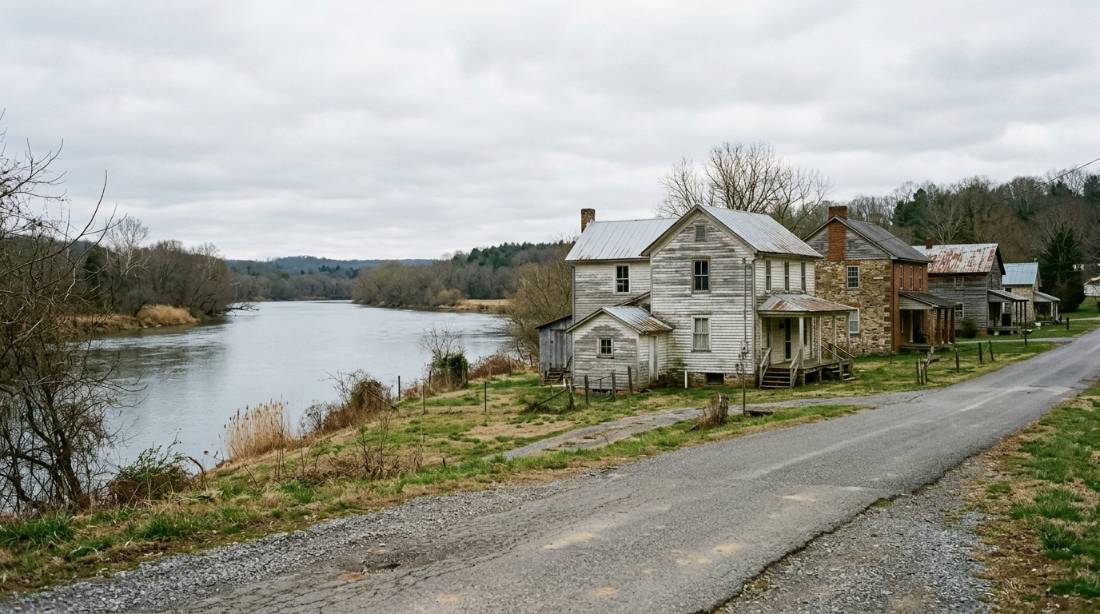
Dayton, Campbell County
Plumbers for Dayton
The neighboring river city to Bellevue and built in the same decades, dense nineteenth-century housing on the lowest ground in Campbell County, behind the floodwall, with the water table close underneath.
Open 24 hours. Tell us the road and what is happening.
- Alexandria · Newport · Bellevue
- Lowest ground in the county
- Combined sewer, floodwall protected
- 24/7 emergency response
Low ground behind a wall
Dayton sits lower than almost anywhere else in Campbell County, on the flat river ground protected by the floodwall. The wall handles the river; it does not handle the water table, which sits high beneath the whole city and works constantly against basement walls, cold joints and every pipe penetration through them.
For any Dayton basement that makes a working sump pump with a backup primary equipment rather than an upgrade. The storms that overwhelm a pump are the same events that cut the power, so a battery or water-powered secondary is doing real work here.
The housing is the same 1870s-to-1900s frame and brick stock as Bellevue, on the same narrow lots, with cast iron waste, galvanized supply and a good deal of mid-century subdivision into apartments. The older core is on a combined sewer, so a hard storm raises the main and the lowest fixture takes the surcharge.
Test the sump before spring
Pour a bucket into the pit and watch it run. If the float sticks or the discharge does not flow, that is a small problem now and a flooded basement in April.
Sump not keeping up? Say how fast the water is rising and we will tell you what to do meanwhile.
Get Help FastCoverage
What we cover around Dayton
Covering a compact city on the river flat, ZIP 41074.
Sixth Avenue
The commercial spine through the middle of the city.
Riverside & the floodwall
The lowest streets, closest to the Ohio, where groundwater is most persistent.
Berry & Clay
Dense pre-1900 residential on narrow lots with alley laterals.
Manhattan Boulevard
Riverfront residential and newer development behind the wall.
Bellevue boundary
The western edge, identical era and identical stock.
Fort Thomas hillside edge
The southern boundary where the ground begins to climb.
Say whether the building is single-family or subdivided, it changes who needs to be there.
Ground conditions
What a pro expects to find in Dayton
Water in the ground, old pipe in the walls, storm water in the sewer.
River terrace
A water table that matters
Ground close to the Ohio where groundwater sits high enough to work on basement walls, cold joints and every pipe penetration.
A sump with a backup, and establishing groundwater versus leak before anyone digs.
Combined sewer
Storm and waste together
The older river-city core carries both in one main. Heavy rain raises it and the lowest opening in the building takes the overflow.
A backwater valve plus a correctly sized sump. Sanitation District No. 1 will confirm what serves your street.
Pre-1950 metal
Galvanized and cast iron
Original galvanized supply narrowed by rust and cast iron waste that has scaled or cracked. Weak upstairs pressure and repeat blockages in one stack are the tells.
Sectional replacement keeps it affordable. A camera survey shows which run is actually the problem.
Any hour, anywhere in Campbell County.
The services called for most in Dayton
Groundwater, sumps, nineteenth-century pipe and combined sewers.
Questions
Dayton questions
It means the river is dealt with. It does not deal with the water table, which sits high under the city regardless, or with a combined sewer surcharging in a heavy storm. A working sump with a backup and backflow protection on the sewer side are still the sensible baseline for any Dayton basement.
Twice a year here, and definitely before spring. Pour a bucket of water into the pit and watch: the float should lift, the pump should run and water should leave through the discharge. If it hums without moving water, or the float sticks, deal with it then. A pump that fails during the storm it was installed for is the most expensive kind.
Look for an access lid, a drain field you avoid with the mower, and no sewer line on the bill. In Campbell County plenty of properties on the outskirts are on tanks while the centre of town is on a main. Knowing which you have decides whether the fix is a pump-out or a rod.
The house side, meaning the tank, switch and controls, is where we start, and that is where most of these faults live. Around Campbell County plenty of properties run on wells, and the same pattern turns up: a tank past its life making the pump do ten times the work it should.
Kentucky sits on limestone, so hard water is the default rather than the exception. Scale shortens the life of heaters and valves and blocks aerators. It is treatable with the right softener, sized to the household and plumbed with a bypass so the outside taps are not softened too.
Repeat blockages are a sign of a defect, not bad luck. Roots, a belly in the line, or a cracked clay joint all behave this way. In older parts of Dayton clay laterals under mature trees are the usual suspects.
A rising bill with nothing visible usually means an underground supply leak or a toilet passing water quietly. Check the meter with everything off: if it still creeps, something is running. That one test tells the plumber a great deal before they arrive in Dayton.
Kentucky licenses plumbers at state level, and we only refer independent professionals who hold current licensing and insurance for the work they take on. You are entitled to ask the person who attends for their details, and a good one will show you without being asked twice.
We cover it. Dayton and the roads around it sit inside the same patch as Bellevue and Fort Thomas, so somebody is usually working within reach. What changes with distance is the arrival window, not whether anyone comes.
Sixth Avenue, the riverside streets or up toward the Fort Thomas line
One number for the whole city, answered around the clock.