North Lexington
Plumbers from Meadowthorpe out to Winburn
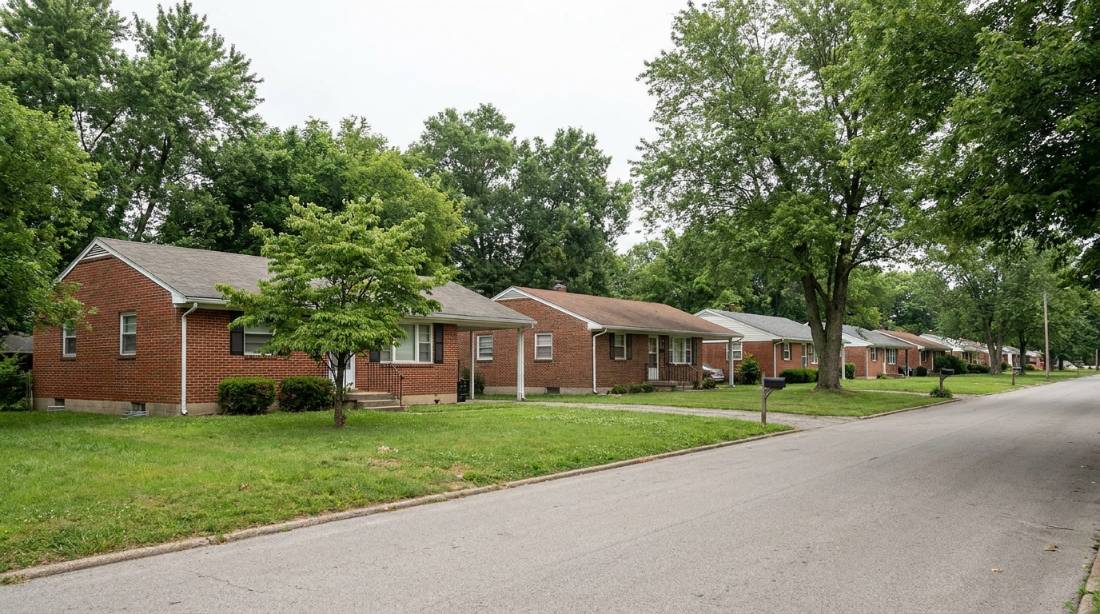
Winburn, Meadowthorpe, Cardinal Valley, Coolavin, Radcliffe and the Georgetown Road and Newtown Pike corridors, largely postwar tract housing, built quickly and built shallow.
Open 24 hours. Give us the street and what is happening.
- Also: Downtown & Central · East Lexington · South Lexington
- Postwar tract housing
- Shallow rock, slab and crawl space
- 24/7 emergency response
Built fast, built shallow, built on rock
North Lexington is where the city expanded hardest between the 1950s and the 1970s. Meadowthorpe, Cardinal Valley, Winburn, Coolavin and the streets off Georgetown Road and Newtown Pike are almost entirely tract housing from that era, which means crawl space and slab far more often than basement, and copper rather than galvanized in most of it.
The distinctive northern problem is depth to rock. Limestone sits close to the surface across much of this part of the county, and when these subdivisions were built the sewer and water laterals went in at whatever depth the rock allowed rather than the depth a textbook would want. Shallow lines freeze more readily in a hard January, sit closer to tree roots, and are more exposed to anything happening at the surface.
Because so much is crawl space and slab, a leak here runs for a long time before anybody notices. There is no basement floor to show a puddle. The first symptoms are a warm patch of floor on a slab, a musty smell under a crawl-space house, a water bill that has drifted upward, or joists that have gone soft.
The equipment is the other half of the list. A subdivision built in one go gets its water heaters, regulators and disposals installed in one go, and they age out together. A street where three neighbors have replaced a tank in a year is telling you something about your own.
Shallow lines and hard frost
If your supply line runs shallow, common across the north side, a sustained freeze reaches it. Insulating exposed runs and crawl-space pipe in autumn costs very little against a burst in January.
Bill drifting up with nothing to see? On a crawl space or slab that is the normal way a leak shows itself here.
Get Help FastNeighborhoods
Where we work in the north end
The north side runs from New Circle out to the Scott County line.
Meadowthorpe
1950s ranch and cape west of Leestown Road, largely on crawl space with mature trees over the laterals.
Cardinal Valley
Postwar tract housing off Versailles Road, slab and crawl space, dense lots.
Winburn
1960s and 1970s subdivision north of New Circle, almost entirely slab.
Coolavin & Radcliffe
Older postwar streets closer to downtown, with a mix of crawl space and basement.
Georgetown Road corridor
Mixed residential and commercial along US 25, running out toward Scott County.
Newtown Pike corridor
Industrial and residential either side of the pike, including newer infill.
Bryan Station area
Postwar housing around the school and along Bryan Station Road.
Northland & Eastland
Late 1950s and 1960s subdivisions northeast of downtown, largely slab.
If your street sits on the boundary between two of these, it makes no difference to the call.
Coverage detail
Communities we cover in North Lexington
This district covers the whole north side, from New Circle out along Georgetown Road and Newtown Pike to the Scott County boundary.
North Lexington
also covers rural west Fayette and appears on that district page too; either route reaches the same phone.
Ground conditions
What a pro expects to find here
Shallow rock, no basement, and equipment that ages out street by street.
Shallow rock
Lines laid where they fitted
Limestone close to the surface meant laterals went in at whatever depth the rock allowed. Shallower pipe freezes sooner, sits nearer roots and is closer to whatever happens above it.
Insulation and freeze protection on exposed and shallow runs, done in autumn rather than during the first hard frost.
Crawl space and slab
Leaks with no early warning
With no basement floor to show a puddle, a leak runs for weeks. A warm spot underfoot on slab, a musty smell under a crawl-space house, or a bill drifting upward.
Crawl space repair and acoustic leak detection so only a small section of floor has to come up.
Batch-built equipment
Whole streets ageing together
A subdivision built in one go had its heaters, regulators and disposals fitted in one go, and tanks last ten to fifteen years.
Mostly plannable work. Replace on your schedule, not the tank’s, and you get to choose the size.
Any hour, anywhere in north Lexington.
The services called for most in this district
Crawl spaces, shallow lines and postwar equipment reaching its end.
Questions
North Lexington questions
Because a good many of them are shallower than they would be elsewhere. Limestone sits close to the surface across the north side, so when these subdivisions were built the laterals went in at whatever depth the rock allowed. Add crawl-space runs and supply pipe in exterior walls and a sustained freeze reaches them. Autumn insulation prevents most of it.
Usually you would not, for a while, which is the problem. The early signs are a musty smell, floors that feel cooler or spongier in one area, a water bill drifting upward, and condensation on ductwork. A look under the house twice a year takes ten minutes and catches most of it before the joists are affected.
On a slab-built house it is almost always a hot-water line leaking into the concrete beneath it. It will not resolve on its own, and the longer it runs the more of the slab gets saturated and the bigger the eventual repair. Acoustic and thermal location pinpoints it so only a small section of floor has to be opened.
If yours is the same age as theirs, plan for it. A subdivision built in one go got its equipment installed in one go, and tanks last roughly ten to fifteen years. Planned replacement is cheaper than an emergency one, you get to choose the size and type, and you avoid a tank weeping onto a finished floor at an inconvenient hour.
Yes, it is the same supply and the same limestone. Scale on heater elements, aerators clogging within months and shortened cartridge-valve life are all normal. Flushing the heater annually helps; a softener sized from an actual water test does considerably more.
Very likely. Mature trees plus a shallow clay or cast iron lateral is the classic root intrusion combination, and the north side has plenty of both. A camera shows whether roots have entered at a joint and how much pipe is left. Jetting clears it; a liner or a replacement section stops it coming back.
No. Kentucky Plumbing HQ is a referral service: we take the call, work out what the job is, and connect you with an independent local plumbing professional who works in your area. Pricing, the work and the workmanship guarantee are between you and the contractor who attends.
Meadowthorpe, Cardinal Valley, Winburn or the Georgetown Road corridor
One number for the whole north side, answered around the clock.